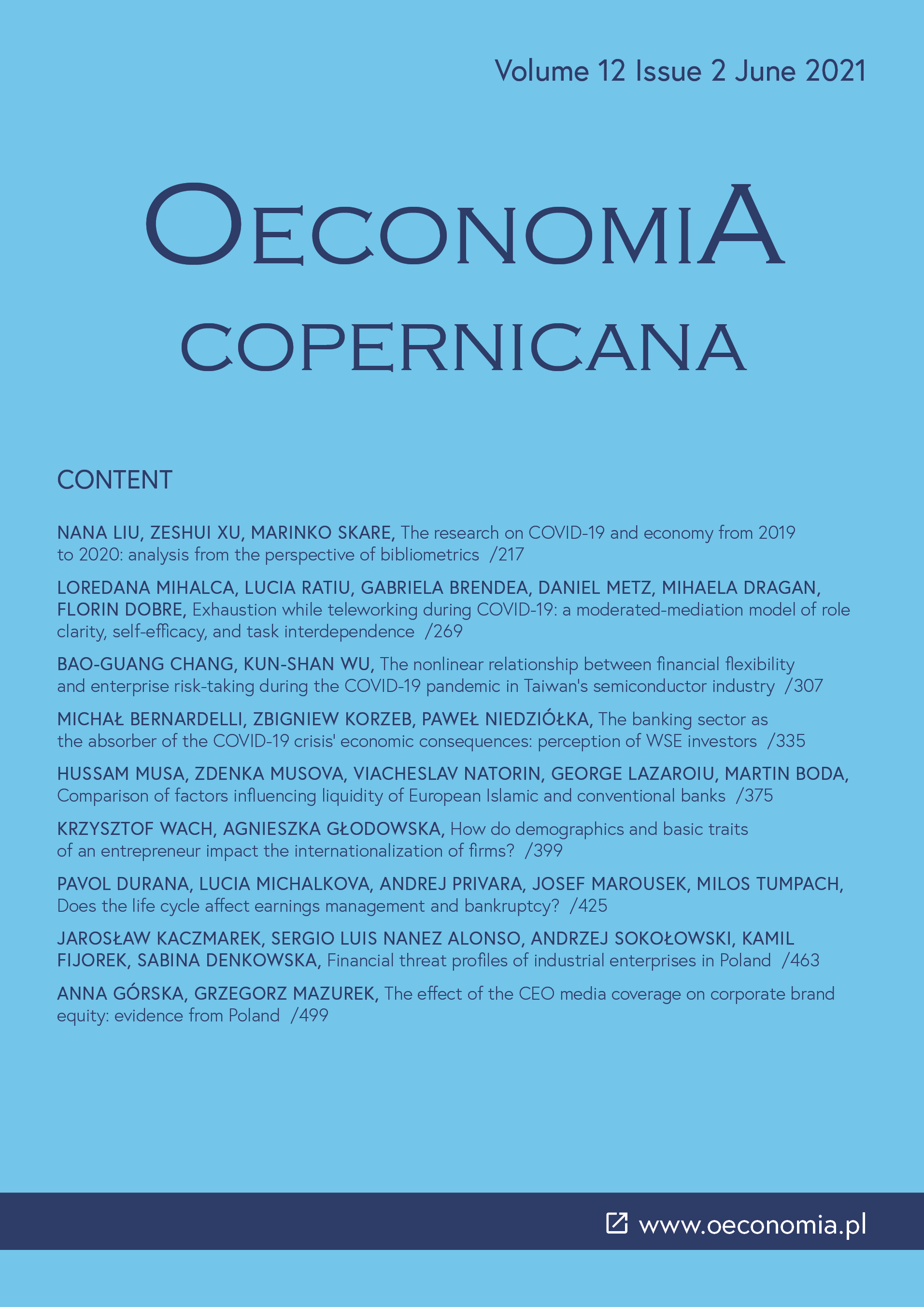


The research on COVID-19 and economy from 2019 to 2020: analysis from the perspective of bibliometrics Nana Liu, Zeshui Xu, Marinko Skare DOI: https://doi.org/10.24136/oc.2021.009 PDF
Exhaustion while teleworking during COVID-19: a moderated-mediation model of role clarity, self-efficacy, and task interdependence Loredana Mihalca, Lucia Lucia Ratiu, Gabriela Brendea, Daniel Metz, Mihaela Dragan, Florin Dobre DOI: https://doi.org/10.24136/oc.2021.010 PDF
The nonlinear relationship between financial flexibility and enterprise risk-taking during the COVID-19 pandemic in Taiwan?s semiconductor industry Bao-Guang Chang, Kun-Shan Wu DOI: https://doi.org/10.24136/oc.2021.011 PDF
The banking sector as the absorber of the COVID-19 crisis? economic consequences: perception of WSE investors Michał Bernardelli, Zbigniew Korzeb, Paweł Niedziółka DOI: https://doi.org/10.24136/oc.2021.012 PDF
Comparison of factors influencing liquidity of European Islamic and conventional banks Hussam Musa, Zdenka Musova, Viacheslav Natorin, George Lazaroiu, Martin Martin Boda DOI: https://doi.org/10.24136/oc.2021.013 PDF
How do demographics and basic traits of an entrepreneur impact the internationalization of firms? Krzysztof Wach, Agnieszka Głodowska DOI: https://doi.org/10.24136/oc.2021.014 PDF
Does the life cycle affect earnings management and bankruptcy? Pavol Durana, Lucia Michalkova, Andrej Privara, Josef Marousek, Milos Tumpach DOI: https://doi.org/10.24136/oc.2021.015 PDF
Financial threat profiles of industrial enterprises in Poland Jarosław Kaczmarek, Sergio Luis Náñez Alonso, Andrzej Sokołowski, Kamil Fijorek, Sabina Denkowska DOI: https://doi.org/10.24136/oc.2021.016 PDF
The effect of the CEO media coverage on corporate brand equity: evidence from Poland Anna Górska, Grzegorz Mazurek DOI: https://doi.org/10.24136/oc.2021.017 PDF