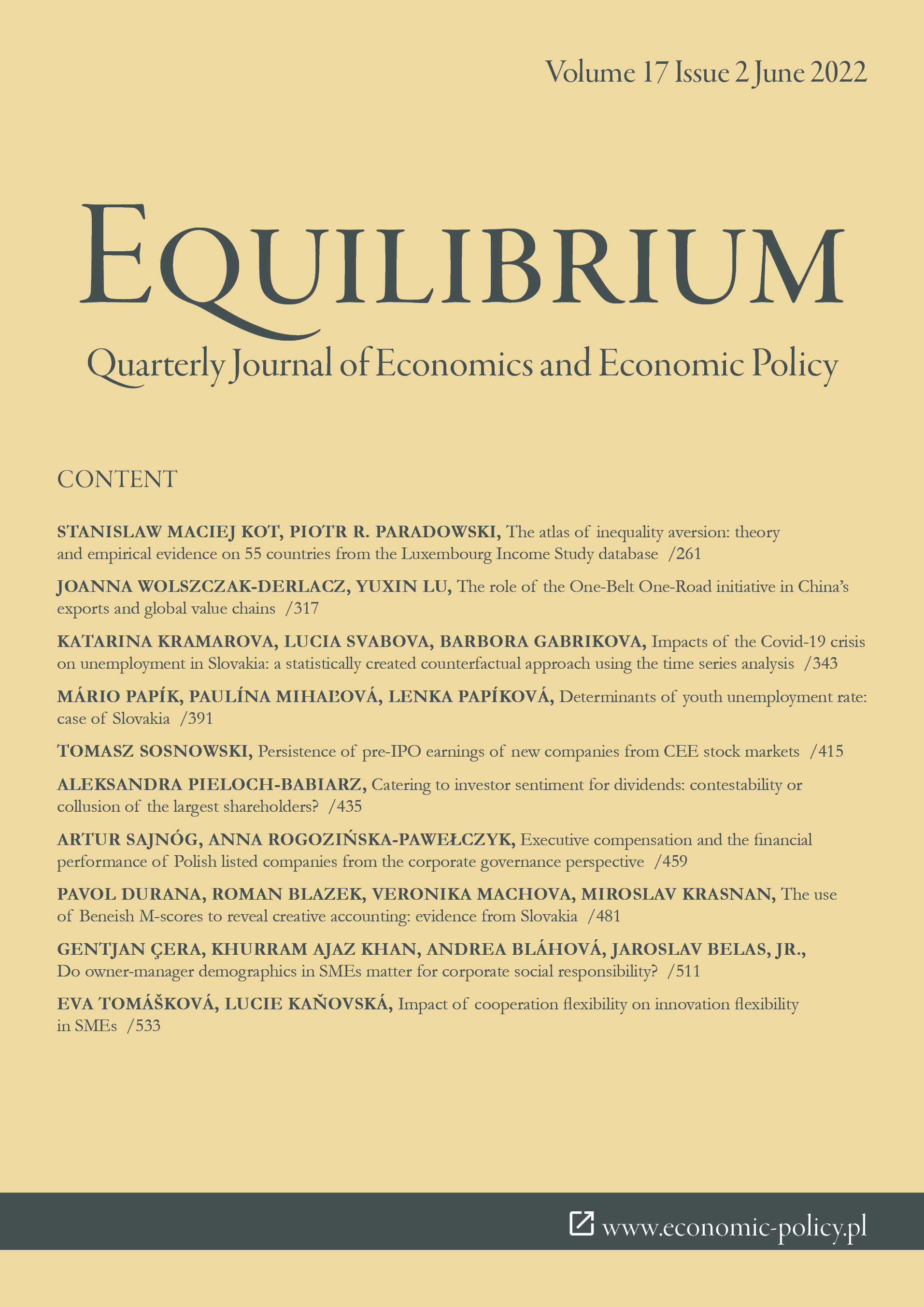
Do owner-manager demographics in SMEs matter for corporate social responsibility?
DOI:
https://doi.org/10.24136/eq.2022.018Keywords:
CSR, corporate social responsibility, owner, manager, SMEsAbstract
Research background: According to the EU agenda, CSR should be considered an integral element of the current organizational strategy, including SMEs. While the debate continues about the optimal approach for successful CSR adaptation in SME, yet there is a need to shed light on the impact of owner-manager?s demographics on CSR practices.
Purpose of the article: The paper aims to examine whether owner-manager?s demographics (age, gender, education) matter for the implementation of CSR or not.
Methods: The study is based on a questionnaire filled in by owner-managers of SMEs operating in Czechia (454) and Slovakia (368). Factor analysis and nonparametric methods are used to test the hypotheses.
Findings & value added: This study shows that the relationships between CSR and owner-manager?s demographics are not alike between Slovakia and Czechia. Compared to owners, the evidence shows that the Czech managers are more oriented toward the CSR practices, while in Slovakia there is no difference. Such finding can be explained by Hofstede culture difference. In addition, analysis demonstrates that female Slovaks are more oriented to CSR than men, while it is not true in Czechia. Moreover, Czech individuals who graduated in the same field as their business are more oriented to the CSR, whereas in Slovakia this is not. In addition, young and old Slovak entrepreneurs are more oriented to the CSR than those 35-55 years old, manifesting a U-shape type of relationship. The originality of this work is manifested by the fact that it enriches the literature since it is among the first studies to analyze the relationships between owner-manager?s demographics and CSR in the SME segment for Czechia and Slovakia.
Downloads
References
Ali, H. Y., Danish, R. Q., & Asrar-ul-Haq, M. (2020). How corporate social responsibility boosts firm financial performance: the mediating role of corporate image and customer satisfaction. Corporate Social Responsibility and Environmental Management, 27(1), 166?177. doi: 10.1002/csr.1781.
DOI: https://doi.org/10.1002/csr.1781
View in Google Scholar
Amin, A., Ali, R., Rehman, R. ur, Naseem, M. A., & Ahmad, M. I. (2021). Female presence in corporate governance, firm performance, and the moderating role of family ownership. Economic Research-Ekonomska Istraživanja. Advance online publication. doi: 10.1080/1331677X.2021.1952086.
DOI: https://doi.org/10.1080/1331677X.2021.1952086
View in Google Scholar
Bann?, M., Filippi, E., & Trento, S. (2021). Women in top echelon positions and their effects on sustainability: a review, synthesis and future research agenda. Journal of Management and Governance. Advance online publicaton. doi: 10.1007/s10997-021-09604-7.
DOI: https://doi.org/10.1007/s10997-021-09604-7
View in Google Scholar
Belas, J., Amoah, J., Petráková, Z., Kliuchnikava, Y., & Bilan, Y. (2020a). Selected factors of SMEs management in the service sector. Journal of Tourism and Services, 11(21), 129?146. doi: 10.29036/JOTS.V11I21.215.
DOI: https://doi.org/10.29036/jots.v11i21.215
View in Google Scholar
Belas, J., Çera, G., Dvorský, J., & Čepel, M. (2020b). Corporate social responsibility and sustainability issues of small- and medium-sized enterprises. Corporate Social Responsibility and Environmental Management, 28(2), 721?730. doi: 10.1002/csr.2083.
DOI: https://doi.org/10.1002/csr.2083
View in Google Scholar
Berényi, L., & Deutsch, N. (2017). Gender differences in attitudes to corporate social responsibility among Hungarian business students. WSEAS Transactions on Business and Economics, 14, 298?310.
View in Google Scholar
Birindelli, G., Iannuzzi, A. P., & Savioli, M. (2019). The impact of women leaders on environmental performance: evidence on gender diversity in banks. Corporate Social Responsibility and Environmental Management, 26(6), 1485?1499. doi: 10.1002/csr.1762.
DOI: https://doi.org/10.1002/csr.1762
View in Google Scholar
Birkinshaw, J., Manktelow, J., D?Amato, V., Tosca, E., & Macchi, F. (2019). Older and wiser? How management style varies with age. MIT Sloan Management Review, 60(4), 75?81.
View in Google Scholar
Brieger, S. A., Anderer, S., Fröhlich, A., Bäro, A., & Meynhardt, T. (2020). Too much of a good thing? On the relationship between CSR and employee work addiction. Journal of Business Ethics, 166(2), 311?329. doi: 10.1007/s10551-019-04141-8.
DOI: https://doi.org/10.1007/s10551-019-04141-8
View in Google Scholar
Buengeler, C., Homan, A. C., & Voelpel, S. C. (2016). The challenge of being a young manager: the effects of contingent reward and participative leadership on team-level turnover depend on leader age. Journal of Organizational Behavior, 37(8), 1224?1245. doi: 10.1002/job.2101.
DOI: https://doi.org/10.1002/job.2101
View in Google Scholar
Busenitz, L. W., & Barney, J. B. (1997). Entrepreneurs and managers in large organizations: biases and heuristics decision-making. Journal of Business Venturing, 12(9?30), 1?23.
DOI: https://doi.org/10.1016/S0883-9026(96)00003-1
View in Google Scholar
Çera, G., Belas, J., Marousek, J., & Çera, E. (2020). Do size and age of small and medium-sized enterprises matter in corporate social responsibility? Economics & Sociology, 13(2), 86?99. doi: 10.14254/2071-789X.2020/13-2/6.
DOI: https://doi.org/10.14254/2071-789X.2020/13-2/6
View in Google Scholar
Chollet, P., & Sandwidi, B. W. (2018). CSR engagement and financial risk: a virtuous circle? International evidence. Global Finance Journal, 38, 65?81. doi: 10.1016/j.gfj.2018.03.004.
DOI: https://doi.org/10.1016/j.gfj.2018.03.004
View in Google Scholar
D?Andrea, A., & Montanini, L. (2015). Corporate social responsibility practices in Italian SMEs. Journal of Business and Economics, 6(12), 2040?2053. doi: 10.1 5341/jbe(2155-7950)/12.06.2015/005.
DOI: https://doi.org/10.15341/jbe(2155-7950)/12.06.2015/005
View in Google Scholar
Dvorský, J., Kozubikova, L., Ključnikov, A., & Ivanova, E. (2022). Owners vs. managers. Disparities of attitudes on the business risk in sme segment. Amfiteatru Economic, 24(59), 174?193. doi: 10.24818/EA/2022/59/174.
DOI: https://doi.org/10.24818/EA/2022/59/174
View in Google Scholar
Dvorský, J., Petráková, Z., Khan, K. A., Formánek, I., & Mikoláš, Z. (2020). Selected aspects of strategic management in the service sector. Journal of Tourism and Services, 11(20), 109?123. doi: 10.29036/jots.v11i20.146.
DOI: https://doi.org/10.29036/jots.v11i20.146
View in Google Scholar
European Union (2020). 2019 SBA fact sheet. European Commission.
DOI: https://doi.org/10.1093/oso/9780198793748.003.0022
View in Google Scholar
Fabrizi, M., Mallin, C., & Michelon, G. (2014). The role of CEO?s personal incentives in driving corporate social responsibility. Journal of Business Ethics, 124(2), 311?326. doi: 10.1007/s10551-013-1864-2.
DOI: https://doi.org/10.1007/s10551-013-1864-2
View in Google Scholar
Fassin, Y., Werner, A., Van Rossem, A., Signori, S., Garriga, E., von Weltzien Hoivik, H., & Schlierer, H. J. (2015). CSR and related terms in SME owner?managers? mental models in six European countries: national context matters. Journal of Business Ethics, 128(2), 433?456. doi: 10.1007/s10551-014-2098-7.
DOI: https://doi.org/10.1007/s10551-014-2098-7
View in Google Scholar
Fernández-Gago, R., Cabeza-García, L., & Nieto, M. (2018). Independent directors? background and CSR disclosure. Corporate Social Responsibility and Environmental Management, 25(5), 991?1001. doi: 10.1002/csr.1515.
DOI: https://doi.org/10.1002/csr.1515
View in Google Scholar
Fijałkowska, J., Zyznarska-Dworczak, B., & Garsztka, P. (2018). Corporate social-environmental performance versus financial performance of banks in Central and Eastern European countries. Sustainability, 10(3), 2-22. doi: 10.3390/su10 030772.
DOI: https://doi.org/10.3390/su10030772
View in Google Scholar
Fraj-Andrés, E., López-Pérez, M. E., Melero-Polo, I., & Vázquez-Carrasco, R. (2012). Company image and corporate social responsibility: reflecting with SMEs? managers. Marketing Intelligence and Planning, 30(2), 266?280. doi: 10.1108/02634501211212019.
DOI: https://doi.org/10.1108/02634501211212019
View in Google Scholar
Garcia-Blandon, J., Argilés-Bosch, J. M., & Ravenda, D. (2019). Exploring the relationship between CEO characteristics and performance. Journal of Business Economics and Management, 20(6), 1064?1082. doi: 10.3846/jbem.2019.104 47.
DOI: https://doi.org/10.3846/jbem.2019.10447
View in Google Scholar
Ghardallou, W. (2022). Corporate sustainability and firm performance: the moderating role of CEO education and tenure. Sustainability, 14(6), 1?16. doi: 10.3390/su14063513.
DOI: https://doi.org/10.3390/su14063513
View in Google Scholar
Glass, C., Cook, A., & Ingersoll, A. R. (2016). Do women leaders promote sustainability? Analyzing the effect of corporate governance composition on environmental performance. Business Strategy and the Environment, 25(7), 495?511. doi: 10.1002/bse.1879.
DOI: https://doi.org/10.1002/bse.1879
View in Google Scholar
Gravetter, F. J., & Wallnau, L. B. (2017). Statistics for the behavioral sciences. CENGAGE Learning.
View in Google Scholar
Grimstad, S. M. F., Glavee-Geo, R., & Fj?rtoft, B. E. (2020). SMEs motivations for CSR: an exploratory study. European Business Review, 32(4), 553?572. doi: 10.1108/EBR-01-2019-0014.
DOI: https://doi.org/10.1108/EBR-01-2019-0014
View in Google Scholar
Hair, J. F., Black, W. C., Babin, B. J., & Anderson, R. E. (2010). Multivariate data analysis. Pearson Education Limited.
View in Google Scholar
Hambrick, D. C., & Mason, P. a. (1984). Upper echelons: the organization as a reflection of its top managers. Academy of Management, 9(2), 193?206.
DOI: https://doi.org/10.5465/amr.1984.4277628
View in Google Scholar
Hatch, C. D., & Stephen, S.-A. (2015). Gender effects on perceptions of individual and corporate social responsibility. Journal of Applied Business and Economics, 17(3), 63?71.
View in Google Scholar
Heikkurinen, P. (2018). Strategic corporate responsibility: a theory review and synthesis. Journal of Global Responsibility, 9(4), 388?414. doi: 10.1108/jgr-06-2018-0020.
DOI: https://doi.org/10.1108/JGR-06-2018-0020
View in Google Scholar
Hofstede, G. (2011). Dimensionalizing cultures: the Hofstede model in context. Online Readings in Psychology and Culture, 2(1), 1?26. doi: 10.9707/2307-0919.1014.
DOI: https://doi.org/10.9707/2307-0919.1014
View in Google Scholar
Idowu, S. O., & Vertigans, S. (2017). Stages of corporate social responsibility-from ideas to impacts. In S. O. Idowu & S. Vertigans (Eds.). Research handbook on corporate social responsibility in context. Springer International Publishing.
DOI: https://doi.org/10.1007/978-3-319-43536-7
View in Google Scholar
Jespersen, K. R., & Bysted, R. (2016). Implementing new product development: a study of personal characteristics among managers. International Journal of Innovation Management, 20(3), 1?23. doi: 10.1142/S1363919616500432.
DOI: https://doi.org/10.1142/S1363919616500432
View in Google Scholar
Jia, Y., Yan, J., Liu, T., & Huang, J. (2019). How does internal and external CSR affect employees? work engagement? Exploring multiple mediation mechanisms and boundary conditions. International Journal of Environmental Research and Public Health, 16(14), 2?17. doi: 10.3390/ijerph16142476.
DOI: https://doi.org/10.3390/ijerph16142476
View in Google Scholar
Jiang, X., & Akbar, A. (2018). Does increased representation of female executives improve corporate environmental investment? Evidence from China. Sustainability, 10(12), 2?19. doi: 10.3390/su10124750.
DOI: https://doi.org/10.3390/su10124750
View in Google Scholar
Jiménez, S. O., García, A. R. G., Osuna, B. A. L., & del Río, S. V. (2021). Entrepreneurial behavior of SMEs and characteristics of the managers of northwest mexico. Social Sciences, 10(1), 1?15. doi: 10.3390/socsci10010008.
DOI: https://doi.org/10.3390/socsci10010008
View in Google Scholar
Johansen, M. S. (2007). The effect of female strategic managers on organizational performance. Public Organization Review, 7(3), 269?279. doi: 10.1007/s11 115-007-0036-1.
DOI: https://doi.org/10.1007/s11115-007-0036-1
View in Google Scholar
Kahreh, M. S., Babania, A., Tive, M., & Mirmehdi, S. M. (2014). An examination to effects of gender differences on the corporate social responsibility (CSR). Procedia - Social and Behavioral Sciences, 109, 664?668. doi: 10.1016/J.SBS PRO.2013.12.525.
DOI: https://doi.org/10.1016/j.sbspro.2013.12.525
View in Google Scholar
Karabasevic, D., Petrovic, G., & Maksimovic, M. (2016). The impact of the levels of education on the perception of corporate social responsibility. Poslovna Ekonomija, 10(2), 106?117. doi: 10.5937/poseko10-12322.
DOI: https://doi.org/10.5937/poseko10-12322
View in Google Scholar
Khan, K. A., Çera, G., & Netek, V. (2019). Perception of the selected business environment aspects by service firms. Journal of Tourism and Services, 10(19), 111?127. doi: 10.29036/jots.v10i19.115.
DOI: https://doi.org/10.29036/jots.v10i19.115
View in Google Scholar
Khan, K. A., Dankiewicz, R., Kliuchnikava, Y., & Oláh, J. (2020). How do entrepreneurs feel bankruptcy? International Journal of Entrepreneurial Knowledge, 8(1), 89?101. doi: 10.37335/ijek.v8i1.103.
DOI: https://doi.org/10.37335/ijek.v8i1.103
View in Google Scholar
Kim, C. H., & Scullion, H. (2013). The effect of corporate social responsibility (CSR) on employee motivation?: a cross-national study. Poznań University of Economics Review, 13(2), 5?30.
DOI: https://doi.org/10.18559/ebr.2013.2.663
View in Google Scholar
Kim, K., Kim, M., & Qian, C. (2018). Effects of corporate social responsibility on corporate financial performance: a competitive-action perspective. Journal of Management, 44(3), 1097?1118. doi: 10.1177/0149206315602530.
DOI: https://doi.org/10.1177/0149206315602530
View in Google Scholar
Kim, M., & Kim, T. (2020). When do CEOs engage in CSR activities? Performance feedback, CEO ownership, and CSR. Sustainability, 12(19), 2?13. doi: 10.3390/su12198195.
DOI: https://doi.org/10.3390/su12198195
View in Google Scholar
Kordsachia, O. (2020). A risk management perspective on CSR and the marginal cost of debt: empirical evidence from Europe. Review of Managerial Science, 15(6), 1611?1643. doi: 10.1007/s11846-020-00392-2.
DOI: https://doi.org/10.1007/s11846-020-00392-2
View in Google Scholar
Kukanja, M., Planinc, T., & Šuligoj, M. (2016). Influence of managers? demographic characteristics on CSR practices in the restaurant industry: the case of Slovenia. Tourism and Hospitality Management, 22(2), 151?172. doi: 10.20867/thm.22.2.2.
DOI: https://doi.org/10.20867/thm.22.2.2
View in Google Scholar
Kulchina, E. (2017). Do foreign entrepreneurs benefit their firms as managers? Strategic Management Journal, 38(8), 1588?1607. doi: 10.1002/smj.2618.
DOI: https://doi.org/10.1002/smj.2618
View in Google Scholar
Kunz, J. (2020). Corporate social responsibility and employees motivation?broadening the perspective. Schmalenbach Business Review, 72(2), 159?191. doi: 10.1007/s41464-020-00089-9.
DOI: https://doi.org/10.1007/s41464-020-00089-9
View in Google Scholar
Larsson, G., & Björklund, C. (2020). Age and leadership: comparisons of age groups in different kinds of work environment. Management Research Review, 44(5), 661?676. doi: 10.1108/MRR-01-2020-0040.
DOI: https://doi.org/10.1108/MRR-01-2020-0040
View in Google Scholar
Leonidas, P., Mary, G., Theofilos, P., & Amalia, T. (2012). Managers? perceptions and opinions towards corporate social responsibility (CSR) in Greece. Procedia Economics and Finance, 1(12), 311?320. doi: 10.1016/s2212-5671(12)00036-6.
DOI: https://doi.org/10.1016/S2212-5671(12)00036-6
View in Google Scholar
Liem, V. T., & Hien, N. N. (2020). The impact of manager?s demographic characteristics on prospector strategy, use of management accounting systems and financial performance. Journal of International Studies, 13(4), 54?69. doi: 10.14254/2071-8330.2020/13-4/4.
DOI: https://doi.org/10.14254/2071-8330.2020/13-4/4
View in Google Scholar
Lu, F., Wang, Z., Toppinen, A., D?Amato, D., & Wen, Z. (2021). Managerial risk perceptions of corporate social responsibility disclosure: evidence from the forestry sector in China. Sustainability, 13(12), 2?16. doi: 10.3390/su13126 811.
DOI: https://doi.org/10.3390/su13126811
View in Google Scholar
Lu, J., Ren, L., Zhang, C., Wang, C., Petkeviciute, N., & Streimikis, J. (2020). Gender difference in corporate social responsibility implementation in Lithuanian SMEs. Oeconomia Copernicana, 11(3), 549?569. doi: 10.24136/OC .2020.023.
DOI: https://doi.org/10.24136/oc.2020.023
View in Google Scholar
Maignan, I., & Ferrell, O. C. (2000). Measuring corporate citizenship in two countries: the case of the United States and France. Journal of Business Ethics 23(3), 283?297. doi: 10.1023/A:1006262325211.
DOI: https://doi.org/10.1023/A:1006262325211
View in Google Scholar
Maon, F., Swaen, V., & Lindgreen, A. (2015). One vision, different paths: an investigation of corporate social responsibility initiatives in Europe. Journal of Business Ethics, 143(2), 405?422. doi: 10.1007/s10551-015-2810-2.
DOI: https://doi.org/10.1007/s10551-015-2810-2
View in Google Scholar
Maqbool, S., & Zameer, M. N. (2018). Corporate social responsibility and financial performance: an empirical analysis of Indian banks. Future Business Journal, 4(1), 84?93. doi: 10.1016/j.fbj.2017.12.002.
DOI: https://doi.org/10.1016/j.fbj.2017.12.002
View in Google Scholar
Metzker, Z., & Streimikis, J. (2020). CSR activities in the Czech SME segment. International Journal of Entrepreneurial Knowledge, 8(1), 49?64. doi: 10.373 35/IJEK.V8I2.101.
DOI: https://doi.org/10.37335/ijek.v8i2.101
View in Google Scholar
Metzker, Z., & Zvarikova, K. (2021). The perception of company employees by SMEs with CSR concept implementation. International Journal of Entrepreneurial Knowledge, 9(1), 81?96. doi: 10.37335/IJEK.V9I1.128.
DOI: https://doi.org/10.37335/ijek.v9i1.128
View in Google Scholar
Meyer, A. (2015). Does education increase pro-environmental behavior? Evidence from Europe. Ecological Economics, 116, 108?121. doi: 10.1016/j.ecolecon. 2015.04.018.
DOI: https://doi.org/10.1016/j.ecolecon.2015.04.018
View in Google Scholar
OECD (2021). Education at a glance 2021. OECD.
DOI: https://doi.org/10.1787/b35a14e5-en
View in Google Scholar
Oh, W. Y., Chang, Y. K., & Cheng, Z. (2016). When CEO career horizon problems matter for corporate social responsibility: the moderating roles of industry-level discretion and blockholder ownership. Journal of Business Ethics, 133(2), 279?291. doi: 10.1007/s10551-014-2397-z.
DOI: https://doi.org/10.1007/s10551-014-2397-z
View in Google Scholar
Öksüzo?lu-Güven, G. (2015). Entrepreneurial ethical decision making. In Handbook of research on business ethics and corporate responsibilities. Hershey PA, USA: IGI Global, 106?122. doi: 10.4018/978-1-4666-7476-9.ch0 06.
DOI: https://doi.org/10.4018/978-1-4666-7476-9.ch006
View in Google Scholar
Oshagbemi, T. (2004). Age influences on the leadership styles and behaviour of managers. Employee Relations, 26(1), 14?29. doi: 10.1108/014254504105068 78.
DOI: https://doi.org/10.1108/01425450410506878
View in Google Scholar
Oshagbemi, T., & Gill, R. (2003). Gender differences and similarities in the leadership styles and behaviour of UK managers. Women in Management Review, 18(6), 288?298. doi: 10.1108/09649420310491468.
DOI: https://doi.org/10.1108/09649420310491468
View in Google Scholar
Pham, H., Pham, T., & Dang, C. N. (2021). Barriers to corporate social responsibility practices in construction and roles of education and government support. Engineering, Construction and Architectural Management. Advance online publicaton. doi: 10.1108/ECAM-03-2020-0199.
DOI: https://doi.org/10.1108/ECAM-03-2020-0199
View in Google Scholar
Quazi, A. M. (2003). Identifying the determinants of corporate managers? perceived social obligations. Management Decision, 41(9), 822?831. doi: 10.1108/00251740310488999.
DOI: https://doi.org/10.1108/00251740310488999
View in Google Scholar
Remišová, A., & Lašáková, A. (2014). CSR-related managerial decision-making preferences in the CEE region (results of the GLOBE student research). Procedia - Social and Behavioral Sciences, 110, 913?922. doi: 10.1016/j.sbsp ro.2013.12.937.
DOI: https://doi.org/10.1016/j.sbspro.2013.12.937
View in Google Scholar
Saeidi, S. P., Sofian, S., Saeidi, P., Saeidi, S. P., & Saaeidi, S. A. (2015). How does corporate social responsibility contribute to firm financial performance? The mediating role of competitive advantage, reputation, and customer satisfaction. Journal of Business Research, 68(2), 341?350. doi: 10.1016/j.jbusres.2014.06. 024.
DOI: https://doi.org/10.1016/j.jbusres.2014.06.024
View in Google Scholar
Sahut, J. M., Peris-Ortiz, M., Teulon, F., & Boubaker, S. (2019). Corporate social responsibility and governance. Journal of Management and Governance, 23(4), 901?912. doi: 10.1007/s10997-019-09472-2.
DOI: https://doi.org/10.1007/s10997-019-09472-2
View in Google Scholar
Saveanu, T., Badulescu, D., Saveanu, S., Abrudan, M., & Badulescu, A. (2021). The role of owner-managers in shaping CSR activity of Romanian SMEs. Sustainability, 13(20), 2?19. doi: 10.3390/su132011546.
DOI: https://doi.org/10.3390/su132011546
View in Google Scholar
Scheibe, S., Walter, F., & Zhan, Y. (2021). Age and emotions in organizations: main, moderating, and context-specific effects. Work, Aging and Retirement, 7(1), 1?8. doi: 10.1093/workar/waaa030.
DOI: https://doi.org/10.1093/workar/waaa030
View in Google Scholar
Seghieri, C., Rojas, D., & Nuti, S. (2015). Are there gender differences in how managers and professionals perceived organizational climate? The case of Tuscan healthcare system. Suma de Negocios, 6(13), 8?16. doi: 10.1016/j.sum neg.2015.04.002.
DOI: https://doi.org/10.1016/j.sumneg.2015.04.002
View in Google Scholar
Slater, D. J., & Dixon-Fowler, H. R. (2010). The future of the planet in the hands of MBAs: an examination of CEO MBA education and corporate environmental performance. Academy of Management Learning and Education, 9(3), 429?441. doi: 10.5465/AMLE.2010.53791825.
DOI: https://doi.org/10.5465/amle.9.3.zqr429
View in Google Scholar
Smekalova, L., Hajek, O., Belas, J., & Machacek, J. (2014). Perception of small and medium entrepreneurship in the Czech Republic. Journal of Competitiveness, 6(4), 41?49. doi: 10.7441/JOC.2014.04.03.
DOI: https://doi.org/10.7441/joc.2014.04.03
View in Google Scholar
Stewart, W. H., & Roth, P. L. (2001). Risk propensity differences between entrepreneurs and managers: a meta-analytic review. Journal of Applied Psychology, 86(1), 145?153. doi: 10.1037/0021-9010.86.1.145.
DOI: https://doi.org/10.1037/0021-9010.86.1.145
View in Google Scholar
Stojanovic, A., Milosevic, I., Arsic, S., Urosevic, S., & Mihajlovic, I. (2020). Corporate social responsibility as a determinant of employee loyalty and business performance. Journal of Competitiveness, 12(2), 149?166. doi: 10.7441/JOC.2020.02.09.
DOI: https://doi.org/10.7441/joc.2020.02.09
View in Google Scholar
Swanson, D. L. (2009). Top managers as drivers for corporate social responsibility. In C. McWilliams & M. Siegel (Eds.). The Oxford handbook of corporate social responsibility. Oxford University Press doi: 10.1093/oxfordhb/97801992 11593.003.0010.
DOI: https://doi.org/10.1093/oxfordhb/9780199211593.003.0010
View in Google Scholar
Tafel-Viia, K., & Alas, R. (2009). Differences and conflicts between owners and top managers in the context of social responsibility. Engineering Economics, 4(64), 86?94.
View in Google Scholar
Tefera, M. A., & He, Y. (2020). Ethiopian managers? corporate social responsibility perceptions: demographics and personal ethical values as predictors. International Journal of Research in Business and Social Science, 9(5), 140?149.
DOI: https://doi.org/10.20525/ijrbs.v9i5.764
View in Google Scholar
Tiep, L. T., Huan, N. Q., & Hong, T. T. T. (2021). Effects of corporate social responsibility on SMEs? performance in emerging market. Cogent Business and Management, 8(1), 1?18. doi: 10.1080/23311975.2021.1878978.
DOI: https://doi.org/10.1080/23311975.2021.1878978
View in Google Scholar
Titko, J., Svirina, A., Tambovceva, T., & Skvarciany, V. (2021). Differences in attitude to corporate social responsibility among generations. Sustainability, 13(19), 1?12. doi: 10.3390/su131910944.
DOI: https://doi.org/10.3390/su131910944
View in Google Scholar
Virglerova, Z., Dobes, K., Kramolis, J., & Kotaskova, A. (2017). The influence of SME owners? education on their perception of business environment in Czech Republic. Economics and Sociology, 10(3), 321?332. doi: 10.14254/2071-789X .2017/10-3/22.
DOI: https://doi.org/10.14254/2071-789X.2017/10-3/22
View in Google Scholar
Yamak, S., Ergur, A., Karatas-Ozkan, M., & Tatli, A. (2019). CSR and leadership approaches and practices: a comparative inquiry of owners and professional executives. European Management Review, 16(4), 1097?1114. doi: 10.1111/em re.12318.
DOI: https://doi.org/10.1111/emre.12318
View in Google Scholar
Zhao, H., & Seibert, S. E. (2006). The big five personality dimensions and entrepreneurial status: a meta-analytical review. Journal of Applied Psychology, 91(2), 259?271. doi: 10.1037/0021-9010.91.2.259.
DOI: https://doi.org/10.1037/0021-9010.91.2.259
View in Google Scholar