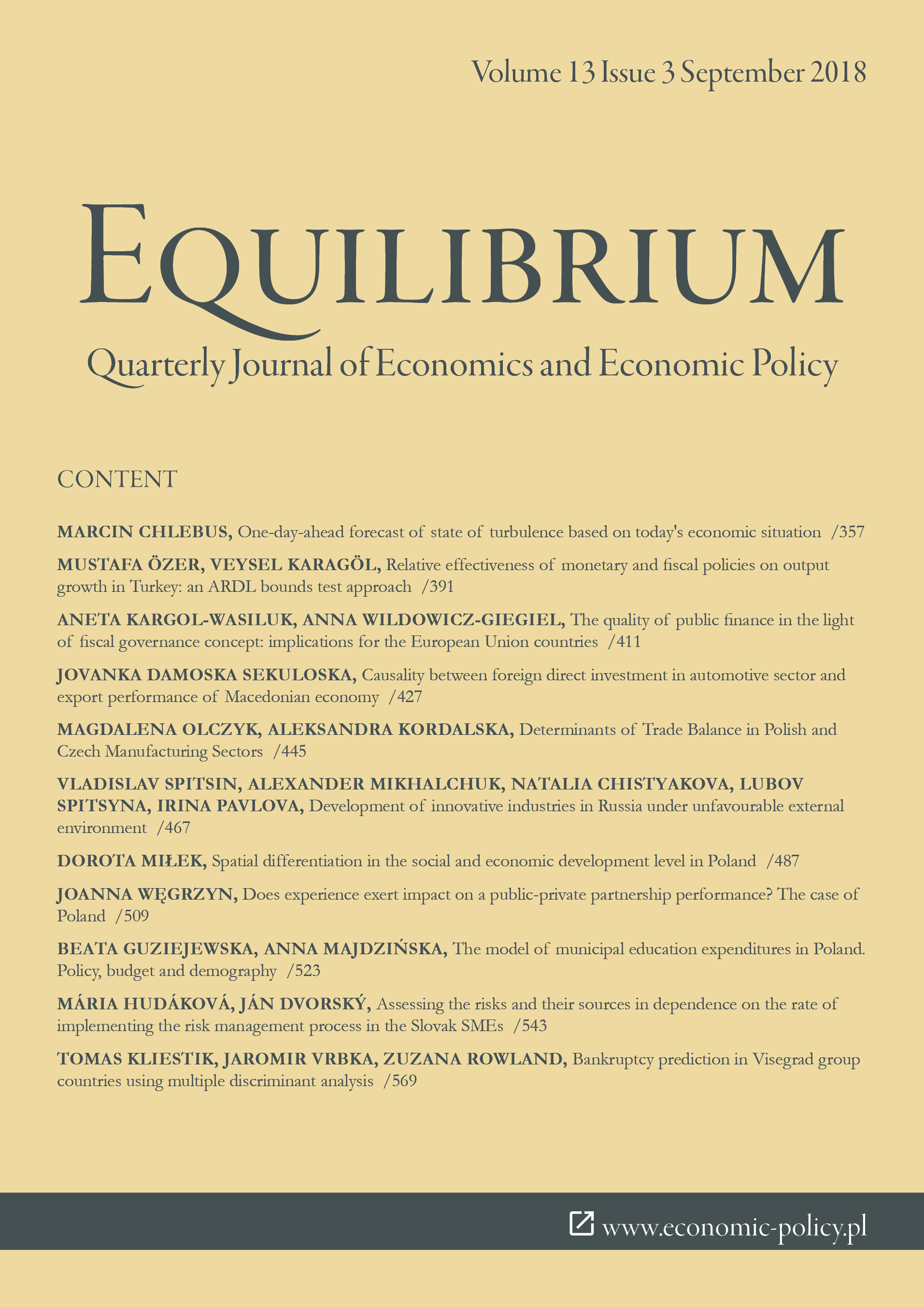
Does experience exert impact on a public-private partnership performance? The case of Poland
DOI:
https://doi.org/10.24136/eq.2018.025Keywords:
survival analysis, public-private partnership (PPP), organizational learning, investment decisionsAbstract
Research background: Researchers traditionally assume that learning is a product of experience. In general, it means that learning can only take place through the attempt to solve a problem and therefore only takes place during activity (Arrow, 1962). On the ground of organizational theory, it has two implications. First, we can agree that repeated activity requires less effort. Second, we can argue that firms undertake activities, with which they have been the most successful in the past and that they expect to be the most successful in the future.
Purpose of the article: The aim of the research is twofold. Firstly, this article aims to investigate if we can identify a relationship between the experience in PPP projects and the performance of initiatives of this kind. Secondly, the article aims to provide an interpretation of the relationship between experience and PPP performance.
Methods: This research investigates factors influencing the survival of PPP projects in Poland over the period 2009?2015. Cox proportional hazard model is utilized to distinguish between PPPs that succeeded to the operation phase and those that were canceled on the procurement stage.
Findings & Value added: The research confirms the existence of a positive relationship between experience in PPP and the outcome of a PPP development.
Downloads
References
Anand, J., Mulotte, L., & Ren, C. R. (2016). Does experience imply learning? Strategic Management Journal, 37. doi: 10.1002/smj.
DOI: https://doi.org/10.1002/smj.2401
View in Google Scholar
Argote, L. (2001). Organizational learning: creating retaining, and transferring knowledge. Boston: Kluwer Academic.
View in Google Scholar
Argyris, C., & Schon, D. (1978). Organizational learning: a theory of action perspective. Addison-Wesley, Reading, MA.
View in Google Scholar
Arrow, K. (1962). The economic implications of learning by doing. The review of economic studies. Review of Economic Studies, 29(3). doi: 10.2307/2295952.
DOI: https://doi.org/10.2307/2295952
View in Google Scholar
Bieszk Stolorz, B. (2018). Stratified Cox model with interactions in analysis of recurrent events. Acta Universitatis Lodziensis. Folia Oeconomica, 335(3). doi: 10.18778/0208-6018.335.14.
DOI: https://doi.org/10.18778/0208-6018.335.14
View in Google Scholar
Buso, M., Marty, F., & Tran, T. (2017). Public private partnership from Budget constraints: looking for debt hiding? International Journal of Industrial Organization, 51. doi: 10.1016/j.ijindorg.2016.12.002.
DOI: https://doi.org/10.1016/j.ijindorg.2016.12.002
View in Google Scholar
Cyert, R. M., & March, J. G. (1963). A behavioral theory of the firm. New York: Prentice Hall, Englewood Cliffs.
View in Google Scholar
De Menezes, A. G., Vieira, J. C., & Moniz, A. I. (2009). Determinants of length of stay - a parametric survival analysis. Advances in Tourism Economics: New Developments, 16. doi: 10.1007/978-3-7908-2124-6_6_.
DOI: https://doi.org/10.1007/978-3-7908-2124-6_6
View in Google Scholar
Falk, M. (2013). A survival analysis of ski lift companies. Tourism Management, 36. doi: 10.1016/j.tourman.2012.10.005.
DOI: https://doi.org/10.1016/j.tourman.2012.10.005
View in Google Scholar
Galilea, P., & Medda, F. (2010). Does the political and economic context influence the success of a transport project? An analysis of transport public-private partnerships. Research in Transportation Economics, 30(1). doi: 10.1016/ j.retrec.2010.10.011.
DOI: https://doi.org/10.1016/j.retrec.2010.10.011
View in Google Scholar
Hajdys, D. (2016). Evolution of the market for public-private partnership projects in EU member states and Poland from 2007 to 2014. Entrepreneurship and Management, 17(1).
View in Google Scholar
Hayward, M. (2002). When do firms learn from their acquisition experience? Evidence from 1990 to 1995. Strategic Management Journal, 23(1). doi: 10.1002/smj.207.
DOI: https://doi.org/10.1002/smj.207
View in Google Scholar
Hammami, M., Ruhashyankiko, J., & Yehoue, E. B. (2006). Determinants of public-private partnerships in infrastructure. IMF Working Paper, WP/06/99. doi: 10.5089/9781451863598.001.
DOI: https://doi.org/10.2139/ssrn.902765
View in Google Scholar
Hart, O. (2003). Incomplete contracts and public ownership: remarks, and an applicaiton to public private partnerships. Economic Journal, 113. doi: 10.1111/1468-0297.00119.
DOI: https://doi.org/10.2139/ssrn.388760
View in Google Scholar
Klijn, E. H., & Koppenjan, J. (2016). The impact of contract characteristics on the performance of public–private partnerships (PPPs). Public Money & Management, 36(6). doi: 10.1080/09540962.2016.1206756.
DOI: https://doi.org/10.1080/09540962.2016.1206756
View in Google Scholar
Levitt, B., & March, J. G. (1988). Organizational learning. Annual Review Sociology, 14(1), doi: 10.1146/annurev.so.14.080188.001535.
DOI: https://doi.org/10.1146/annurev.so.14.080188.001535
View in Google Scholar
McQuaid, R. W., & Scherrer, W. (2009). Changing reasons for public private partnerships (PPPs). Working Papers in Economics and Finance, University of Salzburg, 30(1). doi: 10.1080/09540960903492331.
DOI: https://doi.org/10.1080/09540960903492331
View in Google Scholar
Małkowska, A., Telega, A., Głuszak, M., & Marona, B. (2018). Spatial interdependence in property taxation: the case of Polish municipalities. Equilibrium. Quarterly Journal of Economics and Economic Policy, 13(2). doi: 10.24136/eq.2018.014.
DOI: https://doi.org/10.24136/eq.2018.014
View in Google Scholar
Mikuła, B., (2006). Organizacje oparte na wiedzy. Wydawnictwo Akademii Ekonomicznej w Krakowie, Kraków.
View in Google Scholar
Moszoro, M., Araya, G., Ruiz-Nuñez, F., & Schwartz, J. (2014). Institutional and political determinants of private participation in infrastructure. International Transport Forum Discussion Papers, 2014/15. doi: 10.1787/5jrw2xzj0m7l-en.
DOI: https://doi.org/10.1787/5jrw2xzj0m7l-en
View in Google Scholar
Olejniczak, K. (Eds.) (2012). Organizacje uczące się. Model oparty na wiedzy. Wydawnictwo Naukowe Scholar, Warszawa.
View in Google Scholar
Pollock, A. M., Price, D., & Player, S. (2007). An examination of the UK treasury’s evidence base for cost and time overrun data in UK value-for money policy and appraisal. Public Money & Management, 27(8). doi: 10.1111/j.1467-9302.2007.00568.x.
DOI: https://doi.org/10.1111/j.1467-9302.2007.00568.x
View in Google Scholar
Sentas, P., Angelis, L., & Stamelos, I. (2008). A statistical framework for analyzing the duration of software projects. Empirical Software Engineering, 13(2). doi: 10.1007/s10664-007-9051-7.
DOI: https://doi.org/10.1007/s10664-007-9051-7
View in Google Scholar
Sokołowski, A. (2010). Jak rozumieć i wykonywać analizę przeżycia. StatSoft Polska.
View in Google Scholar
Śmiechowicz, J. (2014). The Use of European Funds in the Implementation of Public-private Partnerships in Poland - Past Experience and Future Possibilities. Zeszyty Naukowe Wyższej Szkoły Bankowej W Poznaniu, 57.
View in Google Scholar
Tasan-Kok, T., & Zaleczna, M. (2010). Public-private partnerships in urban projects. Polish practice and EU regulations. Ernst & Young Poland, Warsaw.
View in Google Scholar
Węgrzyn, J. (2016). The perception of critical success factors for PPP projects in different stakeholder groups. Enterpreneurial Business and Economics Review, 4(2). doi: 10.15678/EBER.2016.040207.
DOI: https://doi.org/10.15678/EBER.2016.040207
View in Google Scholar
Wegrzyn, J., Gluszak, M., & Telega, A. (2018). Infrastructure endowment, financial constraints and willingness to engage in PPPs: the case of Poland. Public Money & Management, 38(7) (forthcoming).
View in Google Scholar
Wojewnik-Filipkowska, A., & Trojanowski, D. (2013). Principles of public-private partnership financing-Polish experience. Journal of Property Investment & Finance, 31(4). doi: 10.1108/JPIF-10-2012-0049.
DOI: https://doi.org/10.1108/JPIF-10-2012-0049
View in Google Scholar
Wright, T. P. (1936). Factors affecting the cost of airplanes. Journal of the Aeronautical Science, 3. doi: 10.2514/8.155.
DOI: https://doi.org/10.2514/8.155
View in Google Scholar
Zollo, M., & Winter, S. G. (2002). Deliberate learning and the evolution of dynamic capabilities. Organization Science, 13(3). doi: 10.1287/orsc.13.3.339 .2780.
DOI: https://doi.org/10.1287/orsc.13.3.339.2780
View in Google Scholar
Zollo, M., Reuer, J. J. & Singh, H. (2002). Interorganizational routines and performance in strategic alliances. Organization Science, 13(6). doi: 10.1287/orsc. 13.6.701.503.
DOI: https://doi.org/10.1287/orsc.13.6.701.503
View in Google Scholar