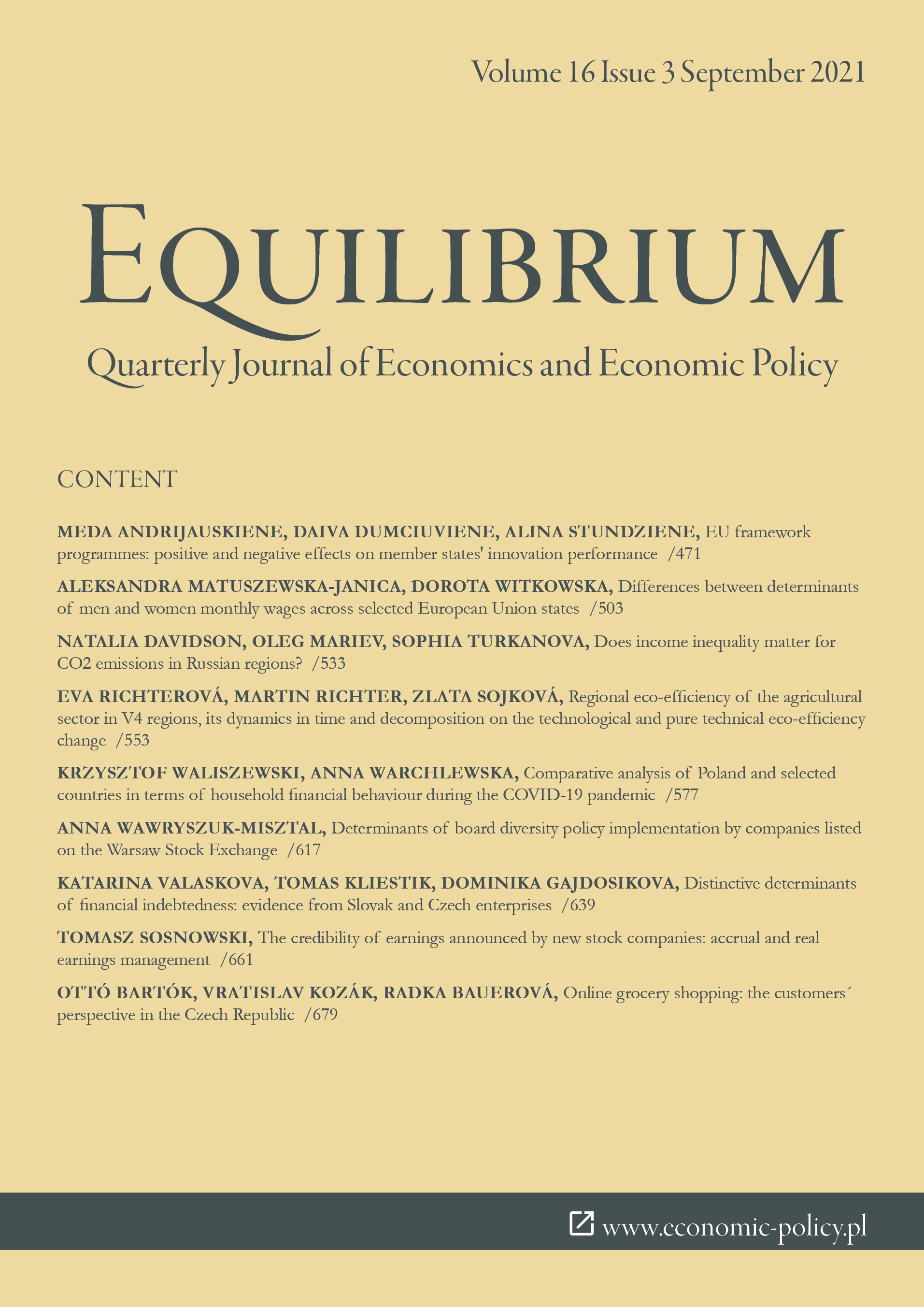
Comparative analysis of Poland and selected countries in terms of household financial behaviour during the COVID-19 pandemic
DOI:
https://doi.org/10.24136/eq.2021.021Keywords:
personal finance management, COVID-19 pandemic, consumer financial behaviourAbstract
Research background: The outbreak of the COVID-19 pandemic, the reduction in income or the total loss of jobs have affected the financial behaviour of consumers worldwide. Managing the budget in times of turbulence and crisis has posed a challenge for households.
Purpose of the article: The aim of the article is to determine to what extent the COVID-19 pandemic has affected the financial behaviour of the inhabitants of various countries and how Poland has stood out from the rest.
Methods: Due to the orderly nature of the questions analysed, non-parametric tests were used in the analysis. The distribution of current expenditure in comparison with the period before the pandemic was analysed, as well as the results of comparative analyses with Mann-Whitney U tests for comparison of Poland with Austria, Belgium, the Czech Republic, France (974), Germany, Italy, Luxemburg, the Netherlands, Romania, Spain, Turkey, the United Kingdom, the USA. A study was carried out on the relationship between planning for the future, having debts and savings and financial behaviour after the COVID-19 pandemic and the metric variables in the group of Poles via Chi square and a series of ? Kendall?s tests.
Findings & value added: There has been a fall in expenditure compared to the period before the pandemic, which may explain the lack of opportunities to spend money, the fall in revenue and the freezing of expenditure for fear of an uncertain future. There has also been a change in the way payments are made. Payment cards and purchases made over the Internet are increasingly popular. In the face of the COVID-19 pandemic, consumers are trying to save more, but not everyone can afford to do so. Long-term value added of this paper is analysis of change in the model of financial behavior of households under the shock of the pandemic in international comparisons of the analysed countries.
Downloads
References
Barrafren, K., Väsfäll, D., & Tinghög, G. (2020). Financial well-being, COVID-19, and the financial better-than-avarage-effect. Journal of Behavioral and Experimental Finance, 28, 100410. doi: 10.1016/j.jbef.2020.10041.
DOI: https://doi.org/10.1016/j.jbef.2020.100410
View in Google Scholar
Bhutta, N., Blair, J., Dettling, L., & Moore, K. (2020). COVID-19, The cares act, and families? financial security. National Tax Journal, 73(3), 645?672. doi: 10.17310/ntj.2020.3.
DOI: https://doi.org/10.17310/ntj.2020.3.02
View in Google Scholar
BioStat Research and Development Center (2020). Retrieved from https://www.bio stat.com.pl/zachowania-konsumentow-koronawirus-maj.php.
View in Google Scholar
Bongini, P., Iwanicz-Drozdowska, M., Roggi, O., & Elliot, V. (2020). Global report on business continuity planning and management (BCP/BCM). Survey results. SSRN. doi: 10.2139/ssrn.3764401.
DOI: https://doi.org/10.2139/ssrn.3764401
View in Google Scholar
Catheriné, S., Miller, S., & Sarin, N. (2020). Relaxing household liquidity constraints through social security. Journal of Public Economics, 198, 104243. doi: 10.1016/j.jpubeco.2020.104243.
DOI: https://doi.org/10.1016/j.jpubeco.2020.104243
View in Google Scholar
Consumer Federation and Foundation for Financial Market Development (2020). The third wave of the pandemic hit the finances of 40- and 50-year-olds the hardest. Retrieved from http://www.federacja-konsumentow.org.pl/270,f inanse-polakow-w-czasie-COVID19--raport-z-badania.html.
View in Google Scholar
Drescher, K., Fessle, P., & Peter, L. (2020). Helicopter money in Europe new evidence on the marginal propensity to consume across European households. Economics Letters, 195, 109416. doi: 10.1016/j.econlet.2020.1094.
DOI: https://doi.org/10.1016/j.econlet.2020.109416
View in Google Scholar
European Consumer Payment Report (2020). Retrieved from https://www.intrum. pl/partner-biznesowy/nasze-raporty/ecpr/european-consumer-payment-report-2 020/.
View in Google Scholar
Eurostat (2020). Impact of COVID-19 on household consumption and savings, Retrieved from https://ec.europa.eu/eurostat/web/products-eurostat-news/-/DDN-20200806-2
View in Google Scholar
Flatters, P., & Willmott, M. (2009). Understanding the postrecession consumer. Harvard Business Review, 87(7/8).
View in Google Scholar
Friedline, T., Chen, Z., & Morrow, S. (2020). Families? financial stress & well-being: the importance of the economy and economic environments. Journal of Family and Economic Issues, 42, 34?51. doi: 10.1007/s10834-020-09694-9.
DOI: https://doi.org/10.1007/s10834-020-09694-9
View in Google Scholar
Li, J., Song., Q., Peng, Ch., & Wu, Y. (2020). COVID-19 pandemic and household liquidity constraints: evidence from micro data. Emerging Markets Finance and Trade, 56(15), 3626?3634. doi: 10.1080/1540496X.2020.18.
DOI: https://doi.org/10.1080/1540496X.2020.1854721
View in Google Scholar
Liu, T., Pan, B., & Yin, Z. (2020). Pandemic, mobile payment, and household consumption: micro-evidence from China. Emerging Markets Finance and Trade, 56(10), 2378?2389. doi: 10.1080/1540496X.2020.17885.
DOI: https://doi.org/10.1080/1540496X.2020.1788539
View in Google Scholar
Lusardi, A., Hasler, A., & Yakoboski, P. J. (2020). Building up financial literacy and financial resilience. Mind & Society. Advance online publication. doi: 10.1007/s11299-020-00246-0.
DOI: https://doi.org/10.1007/s11299-020-00246-0
View in Google Scholar
Marder, T. (2016). Fintech for the consumer market: an overview, consumer compliance Outlook. Retrieved from https://www.consumercomplianceoutlook.or g/2016/third-issue/fintech-for-the-consumer-market-an-overview.
View in Google Scholar
Payment Gateway Market ? Growth, Trends, and Forecast (2020-2025) (2020). Retrieved from https://www.researchandmarkets.com/reports/5176203/payment -gateway-market-growth-trends-and?utm_source=GNOM&utm_medium=Pres sRelease&utm_code=8g3gq4&utm_campaign=1454591+-+Global+Payment +Gateway+Market+Report+2020%3a+Assessment+of+the+Impact+of+COVID-19+on+the+%2440%2b+Billion+Industry&utm_exec=chdo54prd
View in Google Scholar
Statista Survey (2020). COVID-19 barometer. Retrieved from https://www.statista. com/study/72001/COVID-19-barometer.
View in Google Scholar
Statista.com. (2020). Financial situation of households during the COVID-19 pandemic in Poland 2020. Retrieved from https://www.statista.com/statistics/1 111125/poland-financial-situation-of-households-during-the-COVID-19-pande mic/
View in Google Scholar
Sue, E. (2020). Capital markets volatility and COVID-19: background and policy responses. Retrieved from https://crsreports.congress.gov/product/pdf/R/R 46424
View in Google Scholar
Thorun, C., & Diels, J. (2020). Consumer protection technologies: an investigation into the potencial of new digital techonologies for consumer policy. Journal of Consumer Policy, 43(1), 177?191. doi: 10.1007/s10603-019-09411-6.
DOI: https://doi.org/10.1007/s10603-019-09411-6
View in Google Scholar
Valaskova, K., Kramarova, K., & Bartosova, V. (2015). Multi criteria models used in Slovak consumer market for business decision making. Procedia Economics and Finance, 26, 174?182. doi: 10.1016/s2212?5671(15)00913?2.
DOI: https://doi.org/10.1016/S2212-5671(15)00913-2
View in Google Scholar
Van Dalen, H. P., & Henkens. K. (2020). The COVID-19 pandemic: lessons for financially fragile and aging societies. Work, Aging and Retirement, 6(4), 229?232. doi: 10.1093/workar/waaa011.
DOI: https://doi.org/10.1093/workar/waaa011
View in Google Scholar
Waliszewski, K., & Warchlewska, A. (2020a). Attitudes towards artificial intelligence in the area of personal financial planning: a case study of selected countries. Entrepreneurship and Sustainability Issues, 8(2), 399?420. doi: 10.9770/ jesi.2020.8.2(24).
DOI: https://doi.org/10.9770/jesi.2020.8.2(24)
View in Google Scholar
Waliszewski, K., & Warchlewska, A. (2020b). Socio-demographic factors determining expectation experienced while using modern technologies in personal financial management (PFM and robo-advice): a Polish case. European Research Studies Journal, 23(2), 893?904. doi: 10.35808/ersj/1904.
DOI: https://doi.org/10.35808/ersj/1904
View in Google Scholar
Xiao, J., & Tao, CH. (2020). Consumer finance/household finance: the definition and scope. China Finance Review International, 11(1), 1?25. doi: 10.1108/CFR I-04-2020-0032.
DOI: https://doi.org/10.1108/CFRI-04-2020-0032
View in Google Scholar
Yue, P., Korkmaz, A. G., & Zhou, Z. (2020). Household financial decision making Amidst the COVID-19 Pandemic. Emerging Markets Finance, 56(10), 2363?2377. doi: 10.1080/1540496X.2020.178471.
DOI: https://doi.org/10.1080/1540496X.2020.1784717
View in Google Scholar

Downloads
Published
How to Cite
Issue
Section
License
Copyright (c) 2021 Equilibrium. Quarterly Journal of Economics and Economic Policy

This work is licensed under a Creative Commons Attribution 4.0 International License.