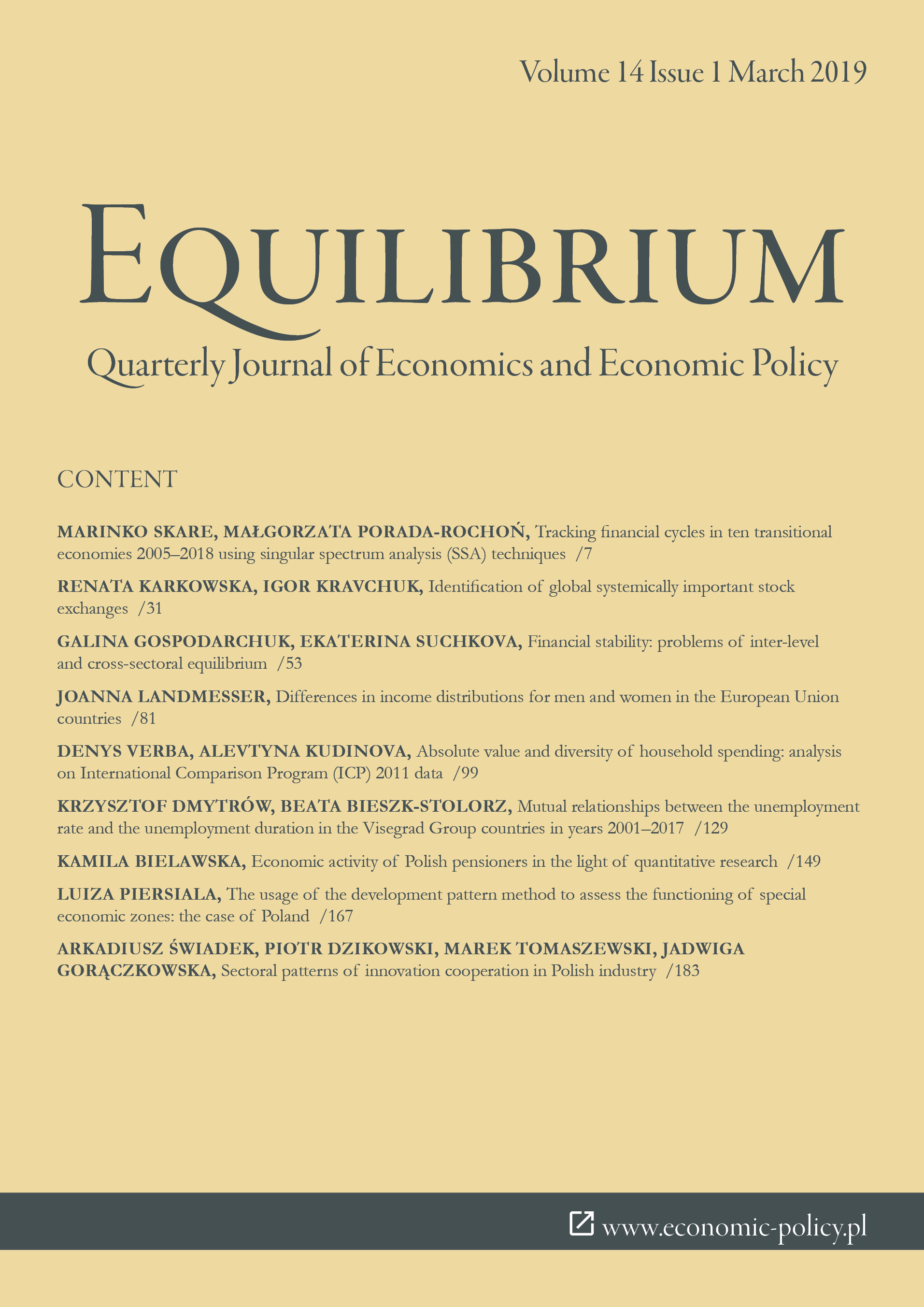
Identification of global systemically important stock exchanges
DOI:
https://doi.org/10.24136/eq.2019.002Keywords:
capital market, systemic risk, stock exchange, macroprudential policy, financial stabilityAbstract
Research background: Increased regulations reducing systemic risk are essentially underpinned by the understanding of the global nature and sources of instability of the financial system. In the economic literature, there are many arguments presented by critical supporters and opponents of measuring and reporting global systemically important entities.
Purpose of the article: In response to the requirements of regulators, the article seeks to identify systematically important regulated stock markets for selected global stock exchanges by developing a composite ratio. Additionally, it provides empirical evidence concerning their risk exploration.
Methods: The proposed method uses weighted average values of indicators grouped in four categories: (1) market size, (2) cross-jurisdictional activity and interconnectedness, (3) substitutability, (4) complexity. The research covers stock exchanges, reported to WFE, spanning the period 2008?2017.
Findings & Value added: The study finds that the problem of systemic risk on global stock exchanges is growing despite numerous prudential regulations. In order to obtain a more complete assessment of market systemic sensitivity, regulators should take into account a wider range of indicators and calculations such as cross-jurisdictional activity and market complexity.
Downloads
References
Adrian, T., & Brunnermeier, M. (2011). CoVaR. NBER Working Paper, 17454.doi: 10.3386/w17454.
DOI: https://doi.org/10.3386/w17454
View in Google Scholar
Barth, J., Prabha, A., & Swagel, P. (2012). Just how big is the too-big-to-fail problem. Journal of Banking Regulation, 13.
DOI: https://doi.org/10.2139/ssrn.2029131
View in Google Scholar
Bijkerk, W., Tendulkar, R., Uddin, S., & Worner, S. (2012). Systemic risk identification in securities markets IOSCO Staff Working Paper, 1.
View in Google Scholar
BIS (2013). Global systemically important banks: updated assessment methodology and the higher loss absorbency requirement.
View in Google Scholar
BIS (2014). The G-SIB assessment methodology – score calculation.
View in Google Scholar
Boss, M., Elsinger, H., Summer, M., & Thurner, S. (2004). An empirical analysis of the network structure of the Austrian interbank market. Oesterreichische Nationalbank Financial stability report. June.
View in Google Scholar
CGFS (2016). Objective-setting and communication of macroprudential policies. CGFS Papers, 57.
View in Google Scholar
Claessens, S. (2014) An overview of macroprudential policy tools. IMF Working Paper, 214. doi: 10.5089/9781484358115.001.
DOI: https://doi.org/10.5089/9781484358115.001
View in Google Scholar
Craig, B., & Von Peter, G. (2010). Interbank tiering and money center banks. Journal of Financial Intermediation, 23(3). doi: 0.1016/j.jfi.2014.02.003.
DOI: https://doi.org/10.1016/j.jfi.2014.02.003
View in Google Scholar
Degryse, H., & Nguyen, G. (2007). Interbank exposures: an empirical examination of contagion risk in the Belgian banking system. International Journal of Central Banking, 3(3). doi: 10.2139/ssrn.1691645.
DOI: https://doi.org/10.2139/ssrn.1691645
View in Google Scholar
EBA (2014). Guidelines on the criteria to determine the conditions of application of Article 131(3) of Directive 2013/36/EU (CRD) in relation to the assessment of other systemically important institutions (O-SIIs).
View in Google Scholar
ESRB (2013). Recommendation on intermediate objectives and instruments of macro-prudential policy.
View in Google Scholar
European Parliament and European Council (2014). Directive on markets in financial instruments and amending Directive 2002/92/EC and Directive 2011/61/EU (MiFID II).
View in Google Scholar
Fang, L., Chen, B., Yu, H., & Qian, Y. (2017). Identifying systemic important markets from a global perspective: Using the ADCC ∆CoVaR approach with skewed-t distribution. Finance Research Letters, 24. doi: 10.1016/j.frl.2017 .08.002.
DOI: https://doi.org/10.1016/j.frl.2017.08.002
View in Google Scholar
Fang, L., Sun, B., Li, H., & Yu, H. (2018). Systemic risk network of Chinese financial institutions. Emerging Markets Review, 35. doi: 1016/j.ememar.2018 .02.003.
DOI: https://doi.org/10.1016/j.ememar.2018.02.003
View in Google Scholar
Forbes, K., & Rigobon, R. (2002). No contagion, only interdependence: measuring stock market comovements. Journal of Finance, 57. doi: 10.1111/0022-1082.00494.
DOI: https://doi.org/10.1111/0022-1082.00494
View in Google Scholar
Fricke, D., & Lux, T. (2015). Core-periphery structure in the overnight money market: evidence from the e-MID trading platform. Computational Economics, 45(3). doi:10.1007/s10614-014-9427-x.
DOI: https://doi.org/10.1007/s10614-014-9427-x
View in Google Scholar
FSB, & IOSCO (2015). Assessment methodologies for identifying non-bank non-insurer global systemically important financial institutions.
View in Google Scholar
FSB, IMF, & BIS (2011). Macroprudential policy tools and frameworks. Update to G20 Finance Ministers and Central Bank Governors.
View in Google Scholar
FSB, IMF, & BIS (2016). Elements of effective macroprudential policies. Lessons from international experience.
View in Google Scholar
Galati, G., & Moessner, R. (2011). Macroprudential policy – a literature review. BIS Working Papers, 337. doi: 10.1111/j.1467-6419.2012.00729.x.
DOI: https://doi.org/10.1111/j.1467-6419.2012.00729.x
View in Google Scholar
Gravelle, T., & Li, F. (2013). Measuring systemic importance of financial institutions: an extreme value theory approach. Journal of Banking and Finance, 37(7). doi: 10.1016/j.jbankfin.2013.01.007.
DOI: https://doi.org/10.1016/j.jbankfin.2013.01.007
View in Google Scholar
Hong, Y., Cheng, S., Liu, Y., & Wang, S. (2004). Extreme risk spillover between Chinese stock market and international stock markets. China Economic Quarterly, 3.
View in Google Scholar
Huang, X., & Zhou, H., & Zhu, H. (2009). A framework for assessing the systemic risk of major financial institutions. Journal of Banking and Finance, 33. doi: 10.1016/j.jbankfin.2009.05.017.
DOI: https://doi.org/10.1016/j.jbankfin.2009.05.017
View in Google Scholar
IMF, BIS, & FSB (2009). Guidance to assess the systemic importance of financial institutions, markets and instruments: initial considerations.
View in Google Scholar
In ’T Veld, D., & Van Lelyveld, I. (2012). Finding the core: network structure in interbank markets. Journal of Banking and Finance, 49. doi: 10.1016/j.jbankfin .2014.08.006.
DOI: https://doi.org/10.1016/j.jbankfin.2014.08.006
View in Google Scholar
Iori, G., De Masi, G., Precup, O., Gabbi, G. & Caldarelli, G. (2008). A network analysis of the Italian overnight money market. Journal of Economic Dynamics and Control, 32. doi: 10.2139/ssrn.841607.
DOI: https://doi.org/10.1016/j.jedc.2007.01.032
View in Google Scholar
Kao, W. S., Kao, T. C., Changchien, C. C., Wang, L. H., & Yeh, K. T. (2018). Contagion in international stock markets after the subprime mortgage crisis. Chinese Economy, 51(2). doi: 10.1080/10971475.2018.1447822.
DOI: https://doi.org/10.1080/10971475.2018.1447822
View in Google Scholar
Kroszner, R., & Strahan, P., (2011). Financial regulatory reform: challenges ahead. American Economic Review, 101(3).
DOI: https://doi.org/10.1257/aer.101.3.242
View in Google Scholar
Langfield, S., Liu, Z., & Ota, T. (2014). Mapping the UK interbank system. Journal of Banking and Finance, 45. doi: 10.1016/j.jbankfin.2014.03.031.
DOI: https://doi.org/10.1016/j.jbankfin.2014.03.031
View in Google Scholar
López-Espinosa, G., Moreno, A., Rubia, A., & Valderrama, L. (2012). Short-term wholesale funding and systemic risk: a global CoVaR approach. Journal of Banking and Finance, 36. doi: 10.1016/j.jbankfin.2012.04.020.
DOI: https://doi.org/10.2139/ssrn.2012231
View in Google Scholar
Morales, L., & Andreosso-O’Callaghan, B. (2012). The current global financial crisis: do Asian stock markets show contagion or interdependence effects? Journal of Asian Economics, 23. doi: 10.1016/j.asieco.2012.09.002.
DOI: https://doi.org/10.1016/j.asieco.2012.09.002
View in Google Scholar
Puhr, C., Seliger, R., & Sigmund, M. (2012). Contagiousness and vulnerability in the Austrian interbank market. Oesterreichische Nationalbank Financial Stability Report, 24.
View in Google Scholar
Roengpitya, R., & Rungcharoenkitkul, P., (2011). Measuring systemic risk and financial linkages in the Thai banking system. Systemic Risk, Basel III, Financial Stability and Regulation. doi: 10.2139/ssrn.1773208.
DOI: https://doi.org/10.2139/ssrn.1773208
View in Google Scholar
Ryan, S. (2008). Accounting in and for the subprime crisis. Accounting Review, 83.
DOI: https://doi.org/10.2139/ssrn.1115323
View in Google Scholar
Schoenmaker, D. (2014). Macroprudentialism. London: CEPR Press.
View in Google Scholar
Walesiak M., & Gatnar E. (2009) Statystyczna analiza danych z wykorzystaniem programu R. Warszawa: Wydawnictwo Naukowe PWN.
View in Google Scholar
Yu, H., Fang, L., Sun, B., & Du, D. (2018). Risk contribution of the Chinese stock market to developed markets in the post-crisis period. Emerging Markets Review, 34. doi: 10.1016/j.ememar.2017.10.006.
DOI: https://doi.org/10.1016/j.ememar.2017.10.006
View in Google Scholar