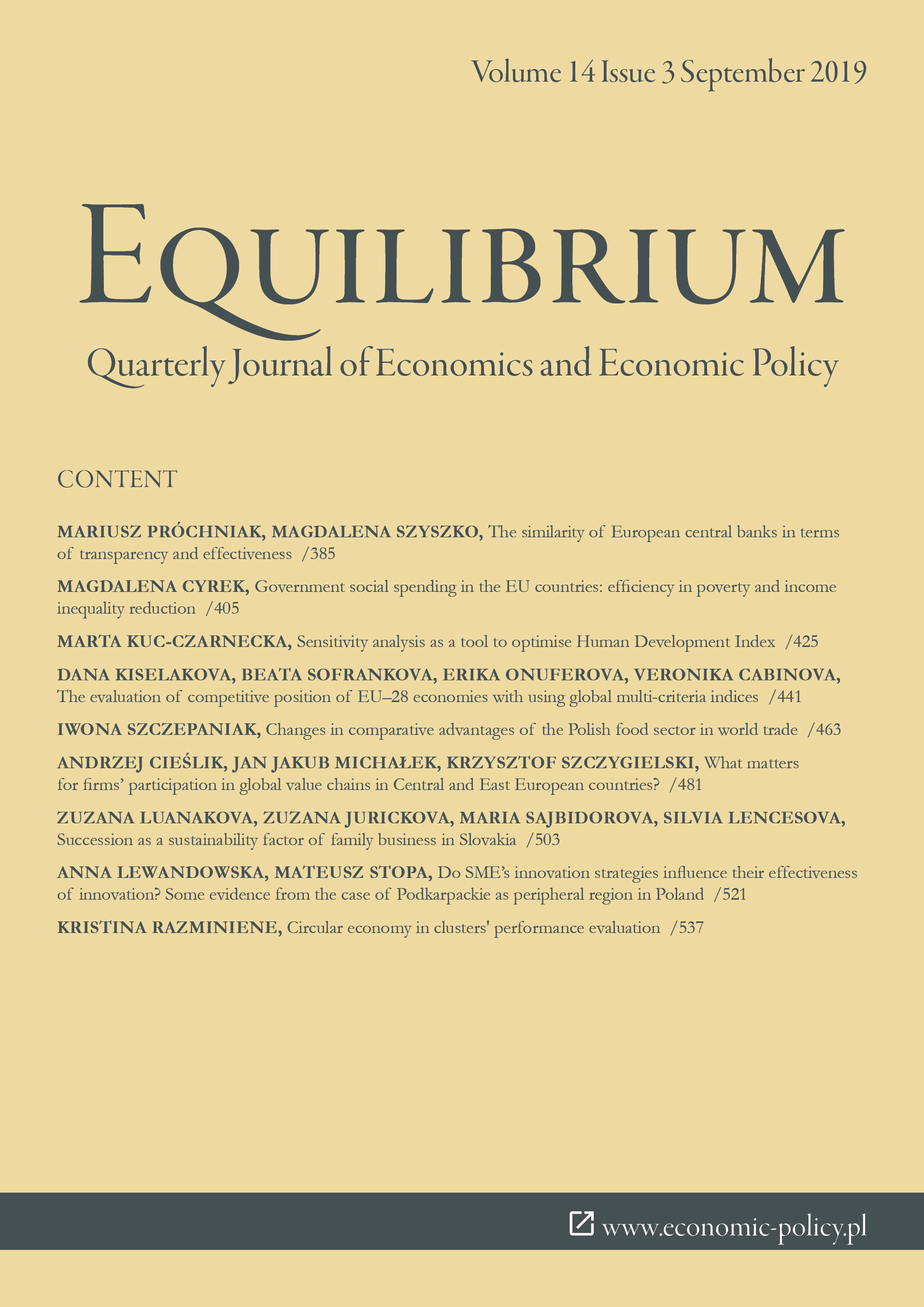
Circular economy in clusters' performance evaluation
DOI:
https://doi.org/10.24136/eq.2019.026Keywords:
clusters, circular economy, resource efficiency, performance evaluation, knowledge transfer, sustainability, sustainable growth, sustainable use of resourcesAbstract
Research background: The value of clusters in developing advanced technology products and services as well as promoting regional growth is acknowledged by many policymakers and researchers (Lee et al., 2012). Hence, clusters are identified as enablers of the circular economy and resource efficiency in this study. Companies aim to enhance competencies and create competitive advantages in global competition and this can be achieved through pulling from a common and accessible pool of resources, information and demand for innovation which means that companies can profit from belonging to a cluster.
Purpose of the article: The main aim of the article is to overview the scientific literature that addresses the circular economy, identify clusters and their role in the circular economy and suggest how small and medium enterprises could engage in a circular economy through clusters' performance development.
Methods: Bibliometric literature analysis enables identifying the latest trends in scientific articles regarding a circular economy and clusters. The analytical hierarchy process (AHP) allows for composing the scheme of the cluster?s competitive advantage within circular economy.
Findings & Value added: The findings suggest that resource efficiency is considered to be one of the most important ambitions and clusters can work as enablers of a circular economy for small and medium enterprises (SMEs), gaining a competitive advantage at the same time. Clusters can encourage and provide conditions in which SMEs would turn to a circular economy. The scheme of Cluster's competitive advantage proposed by the author can help cluster's coordinators, policymakers and all the concerned parties to verify the importance of clusters' involvement in the circular economy.
Downloads
References
Amraoui, B., Ouhajjou, A., Monni, S., El Idrissi, N. E. A., & Tvaronavičienė, M. (2019). Performance of clusters in Morocco in the shifting economic and industrial reforms. Insights Into Regional Development, 1(3). doi: 10.9770/ird. 2019.1.3(4).
DOI: https://doi.org/10.9770/ird.2019.1.3(4)
View in Google Scholar
Bezpalov, V. V., Fedyunin, D. V., Solopova, N. A., Avtonomova, S. A., & Lochan, S. A. (2019). A model for managing the innovation-driven development of a regional industrial complex. Entrepreneurship and Sustainability Issues, 6(4). doi: 10.9770/jesi.2019.6.4(24).
DOI: https://doi.org/10.9770/jesi.2019.6.4(24)
View in Google Scholar
Blomsma, F., & Brennan, G. (2017). The emergence of circular economy: a new framing around prolonging resource productivity. Journal of Industrial Ecology, 21(3). doi: 10.1111/jiec.12603.
DOI: https://doi.org/10.1111/jiec.12603
View in Google Scholar
Boutkhoum, O., Hanine, M., Boukhriss, H., Agouti, T., & Tikniouine, A. (2016). Multi-criteria decision support framework for sustainable implementation of effective green supply chain management practices. SpringerPlus, 5(1). doi: 10.1186/s40064-016-2233-2.
DOI: https://doi.org/10.1186/s40064-016-2233-2
View in Google Scholar
Braun, A. T., Kleine-Moellhoff, P., Reichenberger, V., & Seiter, S. (2018). Case study analysing potentials to improve material efficiency in manufacturing supply chains, considering circular economy aspects. Sustainability, 10(3). doi: 10.3390/su10030880.
DOI: https://doi.org/10.3390/su10030880
View in Google Scholar
Bressanelli, G., Adrodegari, F., Perona, M., & Saccani, N. (2018). Exploring how usage-focused business models enable circular economy through digital technologies. Sustainability, 10(3). doi: 10.3390/su10030639.
DOI: https://doi.org/10.3390/su10030639
View in Google Scholar
Broadbent, C. (2016). Steel’s recyclability: demonstrating the benefits of recycling steel to achieve a circular economy. International Journal of Life Cycle Assessment, 21(11). doi: 10.1007/s11367-016-1081-1.
DOI: https://doi.org/10.1007/s11367-016-1081-1
View in Google Scholar
Cerdas, F., Kurle, D., Andrew, S., Thiede, S., Herrmann, C., Zhiquan, Y., & Kara, S. (2015). Defining circulation factories - a pathway towards factories of the future. Procedia CIRP, 29. doi: 10.1016/j.procir.2015.02.032.
DOI: https://doi.org/10.1016/j.procir.2015.02.032
View in Google Scholar
Cole, C., Gnanapragasam, A., Singh, J., & Cooper, T. (2018). Enhancing reuse and resource recovery of electrical and electronic equipment with reverse logistics to meet carbon reduction targets. Procedia CIRP, 69. doi: 10.1016/j.procir. 2017.11.019.
DOI: https://doi.org/10.1016/j.procir.2017.11.019
View in Google Scholar
Cooper, S. J. G., Giesekam, J., Hammond, G. P., Norman, J. B., Owen, A., Rogers, J. G., & Scott, K. (2017). Thermodynamic insights and assessment of the ‘circular economy’. Journal of Cleaner Production, 162. doi: 10.1016/j.jclepro .2017.06.169.
DOI: https://doi.org/10.1016/j.jclepro.2017.06.169
View in Google Scholar
D’Amato, D., Droste, N., Allen, B., Kettunen, M., Lähtinen, K., Korhonen, J., & Toppinen, A. (2017). Green, circular, bio economy: a comparative analysis of sustainability avenues. Journal of Cleaner Production, 168. doi: 10.1016/j. jclepro.2017.09.053.
DOI: https://doi.org/10.1016/j.jclepro.2017.09.053
View in Google Scholar
Eddelani, O., El Idrissi, N. E. A., & Monni, S. (2019). Territorialized forms of production in Morocco: provisional assessment for an own model in gestation. Insights into Regional Development, 1(1). doi: 10.9770/ird.2019.1.1(1).
DOI: https://doi.org/10.9770/ird.2019.1.1(1)
View in Google Scholar
European Commission. (2018). Circular Economy Strategy - Environment - European Commission. Retrieved from http://ec.europa.eu/environment/ circular-economy/index_en.htm (19.11.2018).
View in Google Scholar
Fomina, A. V., Berduygina, O. N., & Shatsky, A. A. (2018). Industrial cooperation and its influence on sustainable economic growth. Entrepreneurship and Sustainability Issues, 5(3). doi: 10.9770/jesi.2018.5.3(4).
DOI: https://doi.org/10.9770/jesi.2018.5.3(4)
View in Google Scholar
Ghenţa, M., & Matei, A. (2018). Smes and the circular economy: from policy to difficulties encountered during implementation. Amfiteatru Economic, 20(48). doi: 10.24818/EA/2018/48/294.
DOI: https://doi.org/10.24818/EA/2018/48/294
View in Google Scholar
Gregorio, V. F., Pié, L., & Terceño, A. (2018). A systematic literature review of bio, green and circular economy trends in publications in the field of economics and business management. Sustainability, 10. doi: 10.3390/su10114232.
DOI: https://doi.org/10.3390/su10114232
View in Google Scholar
Guo, F., Lo, K., & Tong, L. (2016). Eco-efficiency analysis of industrial systems in the Songhua river basin: a decomposition model approach. Sustainability, 8(12). doi: 10.3390/su8121271.
DOI: https://doi.org/10.3390/su8121271
View in Google Scholar
Haas, W., Krausmann, F., Wiedenhofer, D., & Heinz, M. (2015a). How circular is the global economy?: An assessment of material flows, waste production, and recycling in the European union and the world in 2005. Journal of Industrial Ecology, 19(5). doi: 10.1111/jiec.12244.
View in Google Scholar
Haas, W., Krausmann, F., Wiedenhofer, D., & Heinz, M. (2015b). How circular is the global economy?: An assessment of material flows, waste production, and recycling in the European Union and the world in 2005. Journal of Industrial Ecology, 19(5). doi: 10.1111/jiec.12244.
DOI: https://doi.org/10.1111/jiec.12244
View in Google Scholar
Haupt, M., Vadenbo, C., & Hellweg, S. (2017). Do we have the right performance indicators for the circular economy?: Insight into the Swiss waste management system. Journal of Industrial Ecology, 21(3). doi: 10.1111/jiec.12506.
DOI: https://doi.org/10.1111/jiec.12506
View in Google Scholar
Havierniková, K., & Kordoš, M. (2019). Selected risks perceived by SMEs related to sustainable entrepreneurship in case of engagement into cluster cooperation. Entrepreneurship and Sustainability Issues, 6(4). doi: 10.9770/jesi.2019.6.4(9).
DOI: https://doi.org/10.9770/jesi.2019.6.4(9)
View in Google Scholar
Heyes, G., Sharmina, M., Mendoza, J. M. F., Gallego-Schmid, A., & Azapagic, A. (2018). Developing and implementing circular economy business models in service-oriented technology companies. Journal of Cleaner Production, 177. doi: 10.1016/j.jclepro.2017.12.168.
DOI: https://doi.org/10.1016/j.jclepro.2017.12.168
View in Google Scholar
Hobson, K., Lilley, D., Wilson, G. T., Scott, J. L., Lee, J., & Bridgens, B. (2017). Closing the loop on e-waste: a multidisciplinary perspective. Journal of Industrial Ecology. Advance Online Publication. doi: 10.1111/jiec.12645.
DOI: https://doi.org/10.1111/jiec.12645
View in Google Scholar
Huang, B., McDowall, W., Kemp, R., Türkeli, S., Barteková, E., Doménech, T., & Bleischwitz, R. (2017). Circular economy policies in China and Europe. Journal of Industrial Ecology, 21(3). doi: 10.1111/jiec.12597.
DOI: https://doi.org/10.1111/jiec.12597
View in Google Scholar
Iacovidou, E., Velenturf, A. P. M., & Purnell, P. (2019). Quality of resources: a typology for supporting transitions towards resource efficiency using the single-use plastic bottle as an example. Science of the Total Environment, 647. doi: 10.1016/j.scitotenv.2018.07.344.
DOI: https://doi.org/10.1016/j.scitotenv.2018.07.344
View in Google Scholar
Iuga, A. N. (2016). Waste management in the circular economy. The case of Romania. IOP Conference Series: Materials Science and Engineering, 161(1). doi: 10.1088/1757-899X/161/1/012086.
DOI: https://doi.org/10.1088/1757-899X/161/1/012086
View in Google Scholar
Junnila, S., Ottelin, J., Leinikka, L., Junnila, S., Ottelin, J., & Leinikka, L. (2018). Influence of reduced ownership on the environmental benefits of the circular economy. Sustainability, 10(11). doi: 10.3390/su10114077.
DOI: https://doi.org/10.3390/su10114077
View in Google Scholar
Kalmykova, Y., Rosado, L., & Patrício, J. (2016). Resource consumption drivers and pathways to reduction: economy, policy and lifestyle impact on material flows at the national and urban scale. Journal of Cleaner Production, 132. doi: 10.1016/j.jclepro.2015.02.027.
DOI: https://doi.org/10.1016/j.jclepro.2015.02.027
View in Google Scholar
Lee, C.-S., Ho, J. C., & Niu, K.-H. (2012). Guest editors’ introduction to the special issue on regional clusters and global competitiveness. Competitiveness Review, 22(2). doi: 10.1108/cr.2012.34722baa.001.
DOI: https://doi.org/10.1108/cr.2012.34722baa.001
View in Google Scholar
Li, R. H., & Su, C. H. (2012). Evaluation of the circular economy development level of Chinese chemical enterprises. Procedia Environmental Sciences, 13. doi: 10.1016/j.proenv.2012.01.151.
DOI: https://doi.org/10.1016/j.proenv.2012.01.151
View in Google Scholar
Liu, W., Zhan, J., Li, Z., Jia, S., Zhang, F., & Li, Y. (2018). Eco-efficiency evaluation of regional circular economy: a case study in Zengcheng, Guangzhou. Sustainability, 10(2). doi: 10.3390/su10020453.
DOI: https://doi.org/10.3390/su10020453
View in Google Scholar
Lozano, F. J., Lozano, R., Freire, P., Jiménez-Gonzalez, C., Sakao, T., Ortiz, M. G., & Viveros, T. (2018). New perspectives for green and sustainable chemistry and engineering: approaches from sustainable resource and energy use, management, and transformation. Journal of Cleaner Production, 172. doi: 10.1016/J.JCLEPRO.2017.10.145.
DOI: https://doi.org/10.1016/j.jclepro.2017.10.145
View in Google Scholar
Mendoza, J. M. F., Sharmina, M., Gallego-Schmid, A., Heyes, G., & Azapagic, A. (2017). Integrating backcasting and eco-design for the circular economy: the BECE framework. Journal of Industrial Ecology, 21(3). doi: doi: 10.1111/jiec. 12590.
DOI: https://doi.org/10.1111/jiec.12590
View in Google Scholar
Michelini, G., Moraes, R. N., Cunha, R. N., Costa, J. M. H., & Ometto, A. R. (2017). From linear to circular economy: PSS conducting the transition. Procedia CIRP, 64. doi: 10.1016/j.procir.2017.03.012.
DOI: https://doi.org/10.1016/j.procir.2017.03.012
View in Google Scholar
Milios, L. (2017). Advancing to a circular economy: three essential ingredients for a comprehensive policy mix. Sustainability Science, 2018(13). doi: 10.1007/s 11625-017-0502-9.
DOI: https://doi.org/10.1007/s11625-017-0502-9
View in Google Scholar
Mishenin, Y., Koblianska, I., Medvid, V., & Maistrenko, Y. (2018). Sustainable regional development policy formation: role of industrial ecology and logistics. Entrepreneurship and Sustainability Issues, 6(1). doi: 10.9770/jesi.2018. 6.1(20).
View in Google Scholar
Monni, S., Palumbo, F., & Tvaronavičienė, M. (2017). Cluster performance: an attempt to evaluate the lithuanian case. Entrepreneurship and Sustainability Issues, 5(1). doi: 10.9770/jesi.2017.5.1(4).
DOI: https://doi.org/10.9770/jesi.2017.5.1(4)
View in Google Scholar
Moreau, V., Sahakian, M., van Griethuysen, P., & Vuille, F. (2017). Coming full circle: why social and institutional dimensions matter for the circular economy. Journal of Industrial Ecology, 21(3). doi: 10.1111/jiec.12598.
DOI: https://doi.org/10.1111/jiec.12598
View in Google Scholar
Muranko, Z., Andrews, D., Chaer, I., Newton, E. J., Proudman, P., & Longhurst, M. (2017). Pro-circular behaviours and refrigerated display cabinets: Supporting resource efficiency in the retail refrigeration sector. Energy Procedia, 123. doi: 10.1016/j.egypro.2017.07.235.
DOI: https://doi.org/10.1016/j.egypro.2017.07.235
View in Google Scholar
Nakamura, S., & Kondo, Y. (2018). Toward an integrated model of the circular economy: dynamic waste input–output. Resources, Conservation and Recycling, 139. doi: 10.1016/j.resconrec.2018.07.016.
DOI: https://doi.org/10.1016/j.resconrec.2018.07.016
View in Google Scholar
Niero, M., Hauschild, M. Z., Hoffmeyer, S. B., & Olsen, S. I. (2017). Combining eco-efficiency and eco-effectiveness for continuous loop beverage packaging systems: lessons from the Carlsberg circular community. Journal of Industrial Ecology, 21(3). doi:10.1111/jiec.12554.
DOI: https://doi.org/10.1111/jiec.12554
View in Google Scholar
Niero, M., & Kalbar, P. P. (2019). Coupling material circularity indicators and life cycle based indicators: a proposal to advance the assessment of circular economy strategies at the product level. Resources, Conservation and Recycling, 140. doi: 10.1016/J.RESCONREC.2018.10.002.
DOI: https://doi.org/10.1016/j.resconrec.2018.10.002
View in Google Scholar
Niero, M., & Olsen, S. I. (2016). Circular economy: to be or not to be in a closed product loop? A life cycle assessment of aluminium cans with inclusion of alloying elements. Resources, Conservation and Recycling, 114. doi: 10.1016/j. resconrec.2016.06.023.
DOI: https://doi.org/10.1016/j.resconrec.2016.06.023
View in Google Scholar
Nußholz, J. L. K. (2017). Circular business models: defining a concept and framing an emerging research field. Sustainability, 9(10). doi: 10.3390/su9101810.
DOI: https://doi.org/10.3390/su9101810
View in Google Scholar
Pan, Y., & Li, H. (2016). Sustainability evaluation of end-of-life vehicle recycling based on emergy analysis: a case study of an end-of-life vehicle recycling enterprise in China. Journal of Cleaner Production, 131. doi: 10.1016/j.jclepro. 2016.05.045.
DOI: https://doi.org/10.1016/j.jclepro.2016.05.045
View in Google Scholar
Popa, V. N., & Popa, L. I. (2016). Green acquisitions and lifecycle management of industrial products in the circular economy. IOP Conference Series: Materials Science and Engineering, 161(1). doi: 10.1088/1757-899X/161/1/012112.
DOI: https://doi.org/10.1088/1757-899X/161/1/012112
View in Google Scholar
Raudeliūnienė, J., Davidavičienė, V., & Jakubavičius, A. (2018). Knowledge management process model. Entrepreneurship and Sustainability Issues, 5(3). doi: 10.9770/jesi.2018.5.3(10).
DOI: https://doi.org/10.9770/jesi.2018.5.3(10)
View in Google Scholar
Razminiene, K., & Tvaronavičiene, M. (2018). Detecting the linkages between clusters and circular economy. Terra Economicus, 16(4). doi: 10.23683/2073-6606-2018-16-4-50-65.
View in Google Scholar
Razminienė, K., Tvaronavičienė, M., & Zemlickienė, V. (2016). Evaluation of cluster efficiency measurement tool. Terra Economicus, 14(3). doi: 10.18522/ 2073-6606-2016-14-3-101-111.
DOI: https://doi.org/10.18522/2073-6606-2016-14-3-101-111
View in Google Scholar
Reuter, M. A. (2016). Digitalizing the circular economy. Metallurgical and Materials Transactions B, 47(6). doi: 10.1007/s11663-016-0735-5.
DOI: https://doi.org/10.1007/s11663-016-0735-5
View in Google Scholar
Rivera, X. C. S. (2018). The role of life cycle sustainability assessment in the implementation of circular economy principles in prganizations. Procedia CIRP, 69. doi: 10.1016/J.PROCIR.2017.11.022.
DOI: https://doi.org/10.1016/j.procir.2017.11.022
View in Google Scholar
Rizos, V., Behrens, A., van der Gaast, W., Hofman, E., Ioannou, A., Kafyeke, T., & Topi, C. (2016). Implementation of circular economy business models by small and medium-sized enterprises (SMEs): barriers and enablers. Sustainability, 8(11). doi: 10.3390/su8111212.
DOI: https://doi.org/10.3390/su8111212
View in Google Scholar
Smol, M., Kulczycka, J., & Avdiushchenko, A. (2017). Circular economy indicators in relation to eco-innovation in European regions. Clean Technologies and Environmental Policy, 19. doi: 10.1007/s10098-016-1323-8.
DOI: https://doi.org/10.1007/s10098-016-1323-8
View in Google Scholar
Stewart, R., Niero, M., Murdock, K., & Olsen, S. I. (2018). Exploring the implementation of a circular economy strategy: the case of a closed-loop supply of aluminum beverage cans. Procedia CIRP, 69. doi: 10.1016/j.procir.2017. 11.006.
DOI: https://doi.org/10.1016/j.procir.2017.11.006
View in Google Scholar
Tetsman, I., Bazienė, K., & Viselga, G. (2017). Technologies for sustainable circular business: using crushing device for used tires. Entrepreneurship and Sustainability Issues, 4(4). doi: 10.9770/jesi.2017.4.4(3).
DOI: https://doi.org/10.9770/jesi.2017.4.4(3)
View in Google Scholar
Thomson Reuters (2018). Web of Science [v.5.28] - Web of Science core collection result analysis. Retrieved from Web of Science website: https://wcs.webofknowledge.com/RA/analyze.do?product=WOS&SID=D3wOy3Atek3nfuLcVLb&field=TASCA_JCRCategories_JCRCategories_en&yearSort=false (27.03.2019).
View in Google Scholar
Van der Voet, E., Van Oers, L., Verboon, M., & Kuipers, K. (2018). Environmental implications of future demand scenarios for metals: methodology and application to the case of seven major metals. Journal of Industrial Ecology. Advance Online Publication. doi: 10.1111/jiec.12722.
DOI: https://doi.org/10.1111/jiec.12722
View in Google Scholar
Van Ewijk, S., Stegemann, J. A., & Ekins, P. (2018). Global life cycle paper flows, recycling metrics, and material efficiency. Journal of Industrial Ecology, 22(4). doi: 10.1111/jiec.12613.
DOI: https://doi.org/10.1111/jiec.12613
View in Google Scholar
Vanegas, P., Peeters, J. R., Cattrysse, D., Tecchio, P., Ardente, F., Mathieux, F., & Duflou, J. R. (2018). Ease of disassembly of products to support circular economy strategies. Resources, Conservation and Recycling, 135 doi: 10.1016/ j.resconrec.2017.06.022.
DOI: https://doi.org/10.1016/j.resconrec.2017.06.022
View in Google Scholar
Velenturf, A. P. M., Purnell, P., Tregent, M., Ferguson, J., & Holmes, A. (2018). Co-producing a vision and approach for the transition towards a circular economy: perspectives from government partners. Sustainability, 10(5). doi: 10.3390/su10051401.
DOI: https://doi.org/10.3390/su10051401
View in Google Scholar
Walker, S., Coleman, N., Hodgson, P., Collins, N., & Brimacombe, L. (2018). Evaluating the environmental dimension of material efficiency strategies relating to the circular economy. Sustainability, 10(3). doi: doi: 10.3390/su100 30666.
DOI: https://doi.org/10.3390/su10030666
View in Google Scholar
Wilts, H., von Gries, N., & Bahn-Walkowiak, B. (2016). From waste management to resource efficiency-the need for policy mixes. Sustainability, 8(7). doi: 10.3390/su8070622.
DOI: https://doi.org/10.3390/su8070622
View in Google Scholar
Witjes, S., & Lozano, R. (2016). Towards a more circular economy: proposing a framework linking sustainable public procurement and sustainable business models. Resources, Conservation and Recycling, 112. doi: 10.1016/J.RESCON REC.2016.04.015.
DOI: https://doi.org/10.1016/j.resconrec.2016.04.015
View in Google Scholar
Wuttke, J., Rotter, V. S., Chi, N. K., Asari, M., Sakai, S., Yanagawa, R., & Yano, J. (2017). Waste prevention for sustainable resource and waste management. Journal of Material Cycles and Waste Management, 19(4). doi: 10.1007/ s10163-017-0586-4.
View in Google Scholar
Yang, J., & Černevičiūtė, J. (2017). Cultural and creative industries (CCI) and sustainable development: China’s cultural industries clusters. Entrepreneurship and Sustainability Issues, 5(2). doi: 10.9770/jesi.2017.5.2(6).
DOI: https://doi.org/10.9770/jesi.2017.5.2(6)
View in Google Scholar
Yevhen, M., Koblianska, I., Medvin, V., & Maistrenko, Y. (2018). Sustainable regional development policy formation: role of industrial ecology and logistics. Entrepreneurship and sustainability issues, 6(1). doi: 10.9770/jesi.2018. 6.1(20).
DOI: https://doi.org/10.9770/jesi.2018.6.1(20)
View in Google Scholar
Žižka, M., Valentová, V. H., Pelloneová, N., & Štichhauerová, E. (2018). The effect of clusters on the innovation performance of enterprises: traditional vs new industries. Entrepreneurship and Sustainability Issues, 5(4). doi: 10.9770/ jesi.2018.5.4(6).
DOI: https://doi.org/10.9770/jesi.2018.5.4(6)
View in Google Scholar
Zwirner, O., Iacovidou, E., Velis, C. A., Millward-Hopkins, J., Hahladakis, J. N., Purnell, P., & Busch, J. (2017). A pathway to circular economy: developing a conceptual framework for complex value assessment of resources recovered from waste. Journal of Cleaner Production, 168. doi: 10.1016/j.jclepro .2017.09.002.
DOI: https://doi.org/10.1016/j.jclepro.2017.09.002
View in Google Scholar